
Abstract
Introduction
Here, we presented a very rare case of primary synovial sarcoma localized at the thoracic inlet, which was excised by way of the Grunenwald incision.
Case Presentation
)
 Click Here to Zoom |
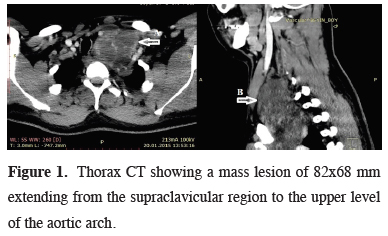
Figure 1: Thorax CT showing a mass lesion of 82x68 mm extending from the supraclavicular region to the upper level of the aortic arch. |
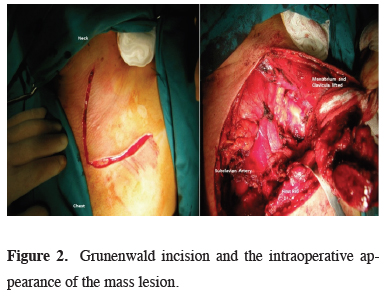
The patient was scheduled for surgery. The Grunenwald incision was performed with an anterior approach (Figure 2).
)
 Click Here to Zoom |
Figure 2: Grunenwald incision and the intraoperative appearance of the mass lesion. |
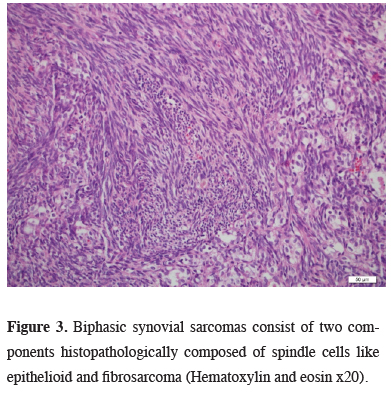
In the exploration, a cystic mass was found tightly adhered the vascular-nerve bundle at the medial, left subclavian artery at the inferior, and brachial plexus, phrenic nerve and scalene muscle at the base. The mass was separated from the surrounding tissues. Wedge resection was performed to the area subject to the invasion in the apicoposterior segment of the upper lobe of the lung ensuring for R0 resection. The postoperative pathology of the patient was reported as biphasic synovial sarcoma (Figure 3). The patient is still being followed up by oncology in his postoperative 2nd year. There were no metastases detected.
)
 Click Here to Zoom |
Figure 3: Biphasic synovial sarcomas consist of two components histopathologically composed of spindle cells like epithelioid and fibrosarcoma (Hematoxylin and eosin x20). |
Discussion
Patients mostly complain about chest pain. There may also be other complaints including a cough, shortness of breath and hemoptysis [2]. In our case, the patient had severe shoulder pain and swelling in the neck because the tumor was close to the brachial plexus. Lung cancer (superior sulcus tumors), neurogenic and malignant triton tumors should be kept in mind in the differential diagnosis of the thoracic inlet masses.
SS are less chemoradiosensitive tumors compared to Ewing sarcomas. The rate at which they respond to chemotherapy ranges between 28-47% in the publications [6,7]. Fluorescence in situ hybridization analysis identification of the diagnostic chromosomal translocation (t[X;18][p11.2;q11.2]), a marker for this tumor, resulting from fusion of the SYT gene on chromosome 18 to either the SSX1 or SSX2 gene on chromosome X was the most reliable diagnostic method [4,8].
Thoracic inlet tumors are challenging operations for thoracic surgeons due to major vascular and nerve structures. Dartavelle uses an L-shaped incision extended from the anterior of the sternocleidomastoid muscle to the intercostal area, and clavicle and manubrium resection are required [5] In literature, this incision is often preferred for anterior Pancoast tumors [6]. Rarely this technique has been described for subclavian artery aneurysms and sarcomas. The conventional thoracotomy incisions are not sufficient for resection in thoracic inlet tumors. In such cases, the Grunenwald incision enables easy access to thoracic inlet tumors. Unlike the Dartevelle technique, the clavicle is protected in this technique [7]. Both techniques were better defined in terms of patient comfort compared to thoracotomy. Since the patient did not accept the additional treatment after the chemotherapy, the decision was taken by the oncology council for surgery. We also preferred an anterior approach in our patient both to detach the tumor from around the brachial plexus and to reach the apical area of the lung. Furthermore, adverse effects on chest wall mechanics well established after thoracotomy have not been observed with the Grunenwald approach.
In conclusion, primary synovial sarcoma has a poorer prognosis compared to other types of sarcomas. Excision should first be considered as the main treatment in these patients. In particular, the Grunenwald incision is an appropriate approach to better control the thoracic inlet anatomy.
Declaration of conflicting interests
The authors declared no potential conflicts of interest with respect to the research, authorship, and/or publication of this article.
Funding
The authors received no financial support for the research, authorship, and/or publication of this article.