
Abstract
Introduction
Case Presentation
)
 Click Here to Zoom |
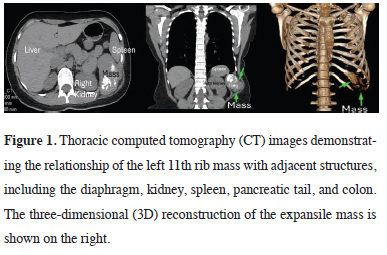
Figure 1: Thoracic computed tomography (CT) images demonstrating the relationship of the left 11th rib mass with adjacent structures, including the diaphragm, kidney, spleen, pancreatic tail, and colon. The three-dimensional (3D) reconstruction of the expansile mass is shown on the right. |
Due to the diagnostic uncertainty and symptomatic presentation, she underwent wide local resection of the 10th and 11th ribs with 2 cm margins, followed by chest wall reconstruction using polypropylene mesh. The postoperative recovery was uneventful, and the patient was discharged on the fourth postoperative day.
Histopathological examination revealed a well-circumscribed, lobulated rib mass (7.8 × 7 × 4 cm) with a homogeneous tan-white cut surface. Microscopically, curvilinear osteoid trabeculae lined by osteoblasts were seen, with spindle cell proliferation showing minimal atypia and mild stromal fibrosis. No high-grade features, necrosis, or significant mitotic activity were observed. Immunohistochemistry: CD34, Desmin, STAT6, MUC4 negative; SATB2 positive; β-catenin cytoplasmic only. Final diagnosis was fibro-osseous lesion with clear resection margins (Figure 2). At nine months, the patient remained asymptomatic and recurrence-free. Written informed consent was obtained from the patient for publication of this case report and any accompanying images.
)
Discussion
The reported age range of post-traumatic fibro-osseous lesions (PTFOL) varies widely, from adolescence to late adulthood, with a mean age in the fifth decade of life [3,4]. Our patient, a 32-year-old female, represents the younger spectrum of reported cases. While a history of trauma has been suggested as a precipitating factor in the majority of PTFOL cases [3], our patient denied any prior traumatic episode. This observation supports the hypothesis that such lesions may also arise in the absence of overt trauma, potentially representing a reactive or developmental process [6].
Radiologically, fibro-osseous rib lesions typically present as well-circumscribed, expansile masses with varying internal density and occasional calcification [1,3]. In our case, CT imaging revealed a large mass with arc-like calcifications and an expansile pattern, raising suspicion for a malignant chest wall tumor. Such radiological overlap complicates the preoperative diagnostic process. A structured diagnostic approach is therefore essential, including initial imaging (CT or MRI), core needle biopsy, and immunohistochemistry (β-catenin, SATB2) to distinguish fibro-osseous lesions from mimickers such as fibrous dysplasia or low-grade sarcomas [7,8]. Definitive histopathology following excision is crucial, particularly in large or symptomatic lesions.
Histopathological examination remains the gold standard for diagnosis. In our case, the initial biopsy yielded a spindle cell neoplasm, which was misleading, and the correct diagnosis was only possible after complete excision and thorough histological evaluation. Fibrous dysplasia and osteoid osteoma are the most common benign rib lesions and can be distinguished from fibro-osseous lesions histologically [3,4]. The absence of nuclear β-catenin staining and positivity for SATB2 further supported the fibro-osseous nature of the lesion in our patient.
Surgical management remains the mainstay for rib tumors when malignancy cannot be excluded preoperatively. A wide local resection of the involved ribs with mesh reconstruction was performed in our patient, with good functional outcome. While some small, asymptomatic fibro-osseous lesions confirmed by biopsy may be managed conservatively [1,5], surgery is warranted in cases with diagnostic uncertainty, symptomatic lesions, or large tumors threatening adjacent structures.
Importantly, long-term outcomes remain poorly defined. Recurrence has not been systematically reported due to the rarity of these lesions and limited follow-up in existing studies [2,4]. Our 9-month disease-free followup, although reassuring, does not allow conclusions about long-term prognosis. Extended surveillance is therefore recommended to clarify recurrence risk and natural history.
In conclusion, fibro-osseous lesions of the rib are rare entities that can closely mimic malignant chest wall tumors. This case highlights the importance of maintaining PTFOL in the differential diagnosis of rib masses, especially when imaging suggests malignancy. A structured diagnostic framework combining radiology, biopsy, and immunohistochemistry is essential, but complete surgical resection remains the definitive management strategy in cases of diagnostic uncertainty (Figure 3). Future multicenter registries could help clarify the natural history and optimal surveillance strategies for these lesions.
)
Figure 3. Diagnostic workflow for the evaluation of rib masses suspicious for fibro-osseous lesions.
Declaration of conflicting interests
The authors declared no conflicts of interest with respect
to the authorship and/or publication of this article.
Funding
The authors received no financial support.
Authors’ contribution
MSN: Conceptualization, Methodology, Supervision,
Writing – review & editing. ZS: Writing – original draft,
Visualization, Data curation. KF: Investigation, Validation
(Radiology).
Reference
This article is an open access article distributed under the terms and conditions of the Creative Commons Attribution (CC BY) license (http://creativecommons.org/ licenses/by/4.0/).