
Abstract
Materials and Methods: This retrospective observational study included 486 adult patients with thoracic trauma, categorized into young adults (18-64 years, n = 366) and geriatric patients (≥65 years, n = 120). Data on demographics, trauma etiology, thoracic pathologies, and concomitant injuries were analyzed using univariate and multivariate binary logistic regression models to identify independent predictors of specific thoracic injuries.
Results: Significant differences were observed in trauma mechanisms; ground-level falls were the predominant mechanism in the geriatric group (p < 0.001), while high-energy mechanisms such as penetrating trauma, assault, and falls from height were significantly more frequent in young adults (p < 0.001). Regarding specific injuries, rib fractures were significantly more common in the geriatric group (p < 0.001). Conversely, pneumothorax and pneumomediastinum were significantly more prevalent in the young adult group (p < 0.001 and p = 0.01, respectively). Multivariate logistic regression analyses revealed that geriatric age was an independent risk factor for the development of rib fractures (OR: 3.99; p = 0.01) and was independently associated with a decreased risk of pneumothorax (OR: 0.36; p = 0.01).
Conclusions: This study revealed that thoracic injury patterns vary with age. Geriatric age is independently associated with rib fractures, whereas pneumothorax and pneumomediastinum are more frequent in young adults. These findings highlight the importance of considering age-specific injury patterns in the evaluation of thoracic trauma.
Introduction
Trauma mechanisms in the geriatric population differ significantly from those in young adults because of decreased cardiopulmonary and musculoskeletal reserves, impaired balance and reaction times, concomitant neurological and psychiatric diseases, polypharmacy, and the presence of environmental risk factors. As a result of this risk profile, low-energy trauma, such as ground-level falls, is the predominant mechanism in geriatric patients, whereas high-energy trauma, such as penetrating injuries, assault, motor vehicle accidents, and falls from height, is more common in young adults [2]. Similarly, thoracic injury patterns following trauma also vary across age groups. Even when individuals are exposed to low-energy trauma, such as ground-level falls, rib fractures are observed more frequently in geriatric patients than in younger individuals because of decreased bone mineral density and reduced chest wall elasticity. Conversely, specific thoracic injuries such as hemothorax and pneumothorax are reported to occur at higher rates in young adults because of their exposure to penetrating and high-energy trauma [3,4].
Despite the increase in the number of emergency department admissions among the aging population, comprehensive studies on which specific thoracic pathologies are more predominant in geriatric patients and the clinical predictability of these conditions are needed [5].
The aim of this study was to evaluate the association between geriatric age and the presence of specific thoracic injuries in patients who presented to the emergency department with trauma and who were diagnosed with thoracic injury.
Materials and Methods
This retrospective observational study was conducted at a tertiary training and research hospital. The study protocol was approved by the Clinical Research Ethics Committee of University of Health Sciences, Kanuni Sultan Süleyman Training and Research Hospital (No: KAEK/2022.04.95). Owing to the retrospective nature of the study, the requirement for informed consent was waived by the same committee. The study was also conducted in compliance with ethical standards and the principles of the Declaration of Helsinki.
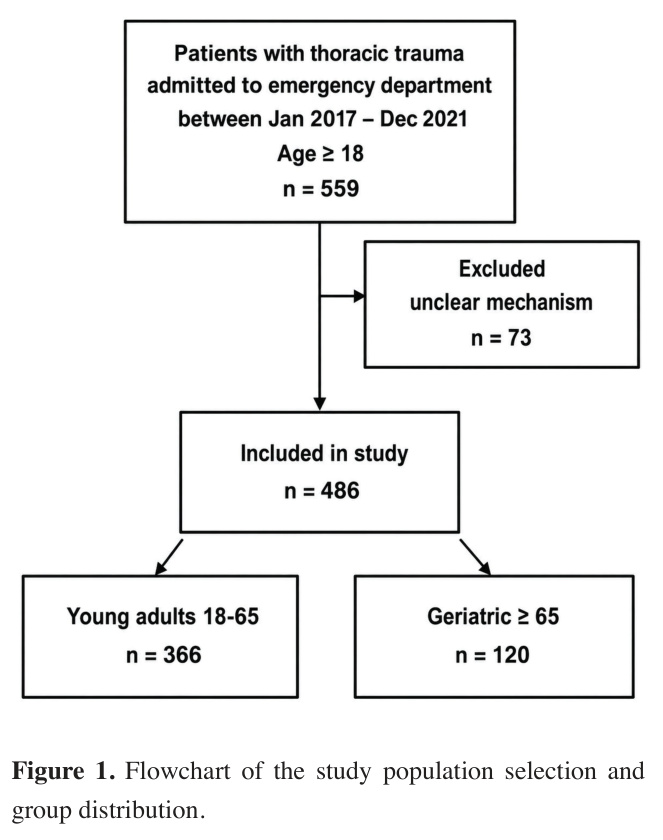
Within the scope of the study, patients aged 18 and older who presented to the emergency department with trauma and who were diagnosed with thoracic injury between 01.01.2017 and 31.12.2021 were retrospectively reviewed via the hospital information management system and archive records. A total of 559 consecutive patients with complete clinical records and radiological data were included in the preliminary evaluation; of these, 73 patients with unclear trauma mechanisms were excluded. Following the evaluation, the 486 patients included in the study were divided into two groups for comparison on the basis of age: young adults (18-64 years) and geriatric (≥65 years) (Figure 1).
)
 Click Here to Zoom |
Figure 1: Flowchart of the study population selection and group distribution. |
Data collection
Demographic data (age and sex), trauma mechanisms (penetrating thoracic trauma, ground-level falls, motor vehicle accidents, assault, and falls from height), thoracic pathologies (pneumothorax, hemothorax, rib fracture, sternum fracture, tension pneumothorax, pneumomediastinum, and pulmonary contusion), concomitant injuries (cranial, abdominal, extremity, and vertebral), emergency department outcomes (admission and discharge), and in-hospital mortality status were retrospectively reviewed and recorded on a preformatted data collection form. In our study, trauma mechanisms such as motor vehicle accidents (including both in-vehicle accidents with an estimated speed >60 km/h and pedestrian/cyclist-vehicle collisions with an estimated speed >30 km/h), falls from a height (≥3 meters), assault, and penetrating injuries were considered high-energy traumas. Conversely, ground-level falls (falls from a standing height or <1 meter) were defined as low-energy traumas. Gunshot wounds and stab wounds were defined as penetrating trauma. Thoracic pathologies were identified through a retrospective review of official computed tomography reports issued by attending radiologists. Diagnoses were based on standardized radiological criteria: pulmonary contusion was defined as non-segmental parenchymal opacification or consolidation; pneumothorax, hemothorax, and pneumomediastinum were defined by the presence of ectopic air or fluid in their respective anatomical compartments. Tension pneumothorax was diagnosed based on radiological signs of significant pressure effect, such as mediastinal shift or diaphragmatic inversion accompanying a pneumothorax. Fractures (ribs and sternum) were defined as a loss of cortical continuity on CT sections. All data were extracted directly from these validated clinical reports. Data were collected by a single researcher who was blinded to the study’s objective; to ensure data quality and consistency, 10% of the randomly selected cases were independently audited by a second researcher.
Statistical Analysis
Statistical analyses were performed using SPSS version 27 (IBM Corp., Armonk, NY, USA) and R-based Jamovi version 2.3.28. Nominal categorical variables are presented as numbers and percentages, whereas continuous variables are presented as medians and interquartile ranges because of their nonnormal distribution. No statistical imputation methods were used during the analysis of missing data; observations with missing data were excluded from the relevant analyses. The distribution characteristics of the continuous variables were evaluated using visual methods (histograms and box-plots) and analytical tests (Kolmogorov-Smirnov, Shapiro-Wilk, skewness, and kurtosis). The Mann-Whitney U test was used to compare continuous variables between the young adult and geriatric groups, as they did not follow a normal distribution. For the comparison of categorical variables, Pearson’s chi-square or Fisher’s exact test was used as appropriate. Within the scope of the study’s objective, univariate and multivariate binary logistic regression models were constructed to evaluate whether geriatric age is an independent predictor of specific thoracic pathologies. Variables found to be significant at p < 0.20 in the univariate analysis were included in the multivariate model. Multicollinearity was assessed using variance inflation factor (VIF) values, and variables with a VIF >5 were excluded from the model. It was observed that certain clinical variables had zero occurrences in specific age subgroups, which may lead to unstable estimates or large standard errors in the logistic regression models. Consequently, variables with zero cell counts were interpreted with caution and, where appropriate, excluded from the final multivariable models to ensure statistical stability. The results of the logistic regression analysis are reported as odds ratios (OR) and 95% confidence intervals (CI). All hypothesis tests were two-tailed, and a p value of <0.05 was considered to indicate statistical significance.
Results
)
When specific thoracic injuries were evaluated, rib fractures were significantly more frequent in the geriatric group (p < 0.001). Conversely, the presence of pneumothorax and pneumomediastinum was significantly greater in the young adult group (p < 0.001 and p = 0.01, respectively). No significant difference was observed between the age groups in terms of other thoracic injuries. Among the concomitant injuries, only extremity injuries were significantly more common in the young adult group (p = 0.02). The in-hospital mortality rate was 2.06%, and no significant difference was found between the age groups (Table 1).
Table 1: Baseline demographic and clinical characteristics of the study population.
According to univariate logistic regression analyses, geriatric age was significantly associated with a decreased risk of pneumothorax development (p < 0.001) and an increased risk of rib fracture development (p < 0.001). Multivariate logistic regression analyses revealed that geriatric age was an independent risk factor for the development of rib fractures (OR: 3.99; 95% CI: 1.36-11.67; p = 0.01), whereas it was independently associated with a decreased risk of pneumothorax development (OR: 0.36; 95% CI: 0.17-0.74; p = 0.01) (Table 2). Other thoracic injuries, including sternum fractures and tension pneumothorax, were excluded from Table 2 due to the low number of cases and lack of statistical significance in regression analyses.
)
Discussion
It has been frequently reported in the literature that the proportion of females among all trauma cases is greater in older age groups. This trend is attributed to the higher female ratio in the elderly population, resulting from the longer life expectancy of women than that of men. This demographic structure is also reflected in trauma cohorts [6,7]. With age, a distinct shift in trauma mechanisms is observed. In young adults, thoracic trauma occurs more frequently because of penetrating and high-energy mechanisms, which are more common in males. Conversely, in older age groups, ground-level falls become the predominant trauma mechanism [8,9]. In our study, the higher proportion of females in the geriatric age group and the identification of ground-level falls as the predominant trauma mechanism are consistent with the literature. These findings suggest that sex distribution and trauma mechanisms shift simultaneously with age and that these two phenomena may be interrelated. Clinically, these findings indicate that the possibility of thoracic injury must be carefully evaluated in elderly and female patients, even in the absence of a high-energy trauma history.
The inverse association found between geriatric age and pneumothorax in our study is consistent with several epidemiological observations reported in the literature. These findings are thought to be related to age-dependent shifts in trauma mechanisms, as well as structural changes in chest wall biomechanics. Pneumothorax is strongly associated with high-energy trauma and penetrating injuries that specifically disrupt pleural integrity, and such mechanisms are more prevalent in younger individuals. In contrast, trauma in the geriatric population frequently occurs via low-energy mechanisms, such as ground-level falls, combined with an age-related increase in chest wall rigidity, leading to the absorption of trauma energy by bony structures rather than its transmission to lung and pleural tissues. These biomechanical characteristics may contribute to the lower incidence of pneumothorax in geriatric patients [10,11]. The significant increase in the risk of pneumothorax development associated with penetrating trauma and thoracoabdominal injuries suggestive of high-energy trauma is also consistent with findings in the literature. Clinically, these findings highlight the importance of considering trauma mechanisms and concomitant injuries alongside age when evaluating the development of pneumothorax.
Numerous studies have reported that rib fractures are more frequent in the geriatric age group and that advanced age is an independent risk factor for the development of rib fractures. This increased risk is attributed to physiological changes such as decreased bone mineral density, loss of chest wall elasticity, and increased agerelated frailty [3,12]. In our study, the finding that geriatric age is significantly and independently associated with the development of rib fractures is consistent with these findings. Furthermore, the independent association found between ground-level falls and the risk of rib fractures in our study may reflect the characteristics of the exposed population rather than a direct causal effect of the mechanism itself. Indeed, it has been reported in the literature that the risk of rib fractures is increased in the geriatric population, where ground-level falls are more prevalent [13]. In this context, the association of ground-level falls with rib fractures despite the inclusion of the age variable in the model can be explained by the partial representation of age-related frailty and exposure patterns through this mechanism. Specifically, underlying osteoporosis may further increase the risk of rib fractures, while neurodegenerative conditions such as Parkinson’s disease often contribute to the high frequency of ground-level falls observed in our geriatric cohort [3,14]. Clinically, these findings highlight that low-energy falls, particularly in older patients, should not be considered minor trauma and underscore the importance of careful clinical and radiological evaluation for rib fractures in this patient group.
The inverse association found between the penetrating trauma mechanism and the development of rib fractures in our study is consistent with findings reported in the literature. In blunt trauma, high-energy forces transmitted to the chest wall over a broad impact area exceed the bending capacity of the ribs, thereby facilitating fracture development. In contrast, in penetrating thoracic injuries, because the trauma energy remains localized along a limited entry path, rib fractures typically occur only when the entry path directly coincides with the bony structure [15,16]. Clinically, these findings indicate that the trauma mechanism must be considered when evaluating the risk of rib fractures.
Although differences were observed in the distribution of pneumomediastinum between age groups in this study, the geriatric population was not identified as a risk factor for the development of pneumomediastinum in the logistic regression analysis. Conversely, the penetrating trauma mechanism was found to be associated with the development of pneumomediastinum. These findings differ from those of studies in the literature that report posttraumatic pneumomediastinum is more commonly associated with blunt trauma [16,17]. This discrepancy may be related to the study’s methodology, the limited patient population, and the distribution of trauma mechanisms within the current sample.
According to the multivariate logistic regression analysis, the inability to identify geriatric age as a significant risk factor for the development of pneumomediastinum, sternal fracture, and tension pneumothorax may be attributed to the absence of these pathologies in the geriatric age group within our sample. The fact that the number of cases was zero in this group hindered the ability of the model to statistically evaluate these associations in a reliable manner. Therefore, rather than indicating a lack of effect of geriatric age, these results reflect statistical limitations inherent to the current data structure.
In the univariate logistic regression analyses for the development of hemothorax and pulmonary contusion, the age variable was not found to be statistically significant and was therefore not included in the multivariate model. These findings suggest that these specific thoracic pathologies may be related to the mechanism and severity of trauma rather than an age-specific risk. Indeed, the development of hemothorax and pulmonary contusion is more closely associated with trauma mechanisms and energy transfer [17-21]. Multivariate logistic regression analysis revealed a significant association between hemothorax development and penetrating trauma, as well as between pulmonary contusion development and high-energy trauma mechanisms such as motor vehicle accidents and falls from height, which is consistent with the literature. Clinically, these findings suggest that focusing on the trauma mechanism independently of age when evaluating the risk of hemothorax and pulmonary contusion may provide more guidance in determining diagnostic approaches and imaging strategies.
Limitations of the study
This study has several limitations. First, the retrospective and single-center design presents limitations regarding the establishment of causal relationships and the generalizability of the findings. Second, the absence of certain rare thoracic pathologies, such as pneumomediastinum, sternal fracture, and tension pneumothorax, in the geriatric age group hindered the interpretation of the multivariate analyses. Additionally, specific comorbidities, including osteoporosis and neurodegenerative diseases, were not individually analyzed due to data constraints. Furthermore, the lack of standardized trauma scoring systems (e.g., injury severity score or new injury severity score) restricts a more comprehensive assessment of overall anatomical injury severity. Consequently, these factors may limit a broader interpretation of trauma-related outcomes. Given these limitations, the results need to be validated by larger-scale studies with prospective designs.
In conclusion, this study demonstrated that geriatric age is associated with specific thoracic injury patterns among patients who are diagnosed with thoracic injury and who are presenting to the emergency department with trauma. While geriatric age was associated with the development of rib fractures, pneumothorax and pneumomediastinum were observed more frequently in young adults. These findings indicate that age and age-specific injury patterns must be considered together during the diagnostic evaluation of patients with thoracic trauma.