
Abstract
Materials and Methods: A retrospective analysis of 41 consecutive patients who underwent robotic-assisted thoracic surgery (RATS) for mediastinal lesions between December 2023 and December 2025 was conducted. Procedures included lateral decubitus and subxiphoid approaches. To mitigate variations in case complexity, an Observed-Expected (O-E) approach-adjusted Cumulative Sum (CUSUM) model was employed for both access/docking time (operating room team adaptation) and console time (procedural adaptation). Phase 1 (learning) and Phase 2 (proficiency) were compared.
Results: The mean age was 44.8 ± 13.4 years. The approach-adjusted console time CUSUM demonstrated an inflection point at case 16, whereas the access/docking time CUSUM reached inflection at case 24. Comparing Phase 1 (n = 16) and Phase 2 (n = 25), the median O-E console time deviation showed a trend toward improvement from +10.0 to -13.9 minutes (p = 0.219), despite an increased proportion of technically demanding subxiphoid cases in Phase 2. Estimated blood loss significantly decreased in Phase 2 (0.0 mL vs. 10.0 mL, p = 0.025). The safety profile remained high, with no conversions in the learning phase, low postoperative complications (n = 2 vs. n = 2), and zero mortality.
Conclusions: The implementation of a newly established robotic mediastinal surgery program demonstrates feasibility with acceptable short-term outcomes when preceded by structured training. A dual-axis approach-adjusted CUSUM analysis suggests that procedural proficiency and team adaptation occur at different phases, guiding safe expansion to complex approaches.
Introduction
Despite these clear technical advantages, the implementation of a newly established robotic surgery program requires navigating a steep and multifaceted learning curve. The adaptation process in robotic surgery is inherently dual-axis; it involves not only the primary console surgeon's procedural proficiency but also the spatial orientation and operational efficiency of the entire operating room (OR) team, which is predominantly reflected in the access and docking times [3,4]. Furthermore, modern mediastinal robotic programs increasingly utilize tailored approaches, incorporating both lateral decubitus and multi-portal subxiphoid techniques depending on the target compartment. This procedural and anatomical heterogeneity significantly complicates the objective assessment of surgical proficiency.
Traditional learning curve analyses that rely solely on raw operative times often fail to account for these inherent variations in case complexity (e.g., radical thymectomy versus simple cyst enucleation), potentially leading to inaccurate estimations of surgical proficiency. The Cumulative Sum (CUSUM) methodology has been firmly established as a robust statistical tool to sequentially monitor surgical performance and ensure patient safety during the learning phase [3,5]. However, to accurately evaluate a heterogeneous cohort without penalizing the surgeon for adopting complex techniques later in the series, an approach-adjusted methodology is imperative.
Therefore, the objective of this study was to evaluate the safety profile and the dual-axis learning curve, distinguishing between OR team adaptation and procedural proficiency, of a newly established robotic mediastinal surgery program. By employing an approach-adjusted CUSUM methodology, this study aimed to objectively define the proficiency thresholds across a mix of anatomical compartments and diverse surgical approaches.
Materials and Methods
Following approval by the Institutional Review Board of Başakşehir Çam and Sakura City Hospital (Approval Date: 29.12.2025, No:KAEK/24.12.2025.397) regarding the retrospective analysis of clinical data, a review of the maintained database was performed. Between 15 December 2023 and 15 December 2025, 41 consecutive patients who underwent robotic-assisted thoracic surgery (RATS) for mediastinal lesions at a single institution were included in the study. All procedures were performed by a dedicated thoracic surgery team as part of a newly established institutional robotic surgery program. Prior to the initiation of the program, formal structured robotic thoracic surgery training was completed to ensure a standardized approach to console mechanics, team coordination, and patient safety.
Surgical technique and data collection
All procedures were performed using a multi-portal technique with the da Vinci robotic surgical system (Intuitive Surgical, Sunnyvale, CA, USA). The surgical approach - right lateral decubitus, left lateral decubitus, or a multiportal subxiphoid approach (utilizing a subxiphoid camera port combined with bilateral subcostal or intercostal working arms) - was tailored according to the lesion's location (anterior vs. posterior mediastinum), pathology, and the patient's anatomical characteristics. Three robotic arms were utilized in all cases, while the necessity of an additional assistant port was determined dynamically based on the complexity of the case.
Definition of variables
The primary endpoints of the study were the surgical proficiency metrics, specifically separated into team adaptation and procedural adaptation:
Access and docking time: Defined as the time (in minutes) from the initial skin incision for port placement to the successful attachment of the robotic arms to the trocars. This metric was utilized to evaluate the OR team's learning curve regarding spatial orientation and setup.
Console time: Defined as the duration (in minutes) the primary surgeon spent operating at the console. This metric evaluated the procedural learning curve.
Total operative time: Defined as the time from skin incision to skin closure.
Secondary endpoints included safety profile metrics: estimated blood loss, conversion to VATS or thoracotomy, intraoperative complications, and 30-day postoperative morbidity graded according to the Clavien-Dindo classification.
Statistical Analysis
Statistical analysis was performed using Python version 3.10 (Python Software Foundation, Wilmington, DE, USA) utilizing the SciPy and Pandas libraries. Continuous variables were expressed as mean ± standard deviation (SD) or median with interquartile range (IQR), depending on the normality of distribution assessed by the Shapiro-Wilk test. Categorical variables were presented as frequencies and percentages.
To objectively define the learning phases, the Cumulative Sum (CUSUM) methodology was employed. Due to the inherent temporal differences between distinct surgical approaches, an Observed-Expected (O-E) approach-adjusted CUSUM model was utilized for both access/docking time and console time. The expected time (μ) was explicitly derived from the mean time of the corresponding surgical approach group (subxiphoid vs. lateral). Therefore, this methodology serves to mitigate approach-related temporal confounding and should be interpreted as an approachadjusted O-E CUSUM, rather than a multivariable approach-adjusted model incorporating individual patient factors and specific pathologies. The CUSUM series was defined by the equation: CUSUMn = ∑ (Xi - µ) where Xi represents the observed time for the i-th case.
The inflection point on the CUSUM curve identified the transition from the "learning phase" (Phase 1) to the "proficiency phase" (Phase 2). Patient demographics, operative parameters, and safety metrics were compared between these two phases using the Student's t-test or Mann-Whitney U test for continuous variables, and the Chi-square or Fisher's exact test for categorical variables. A p-value of <0.05 was considered statistically significant.
Results
)
Learning curve and CUSUM analysis
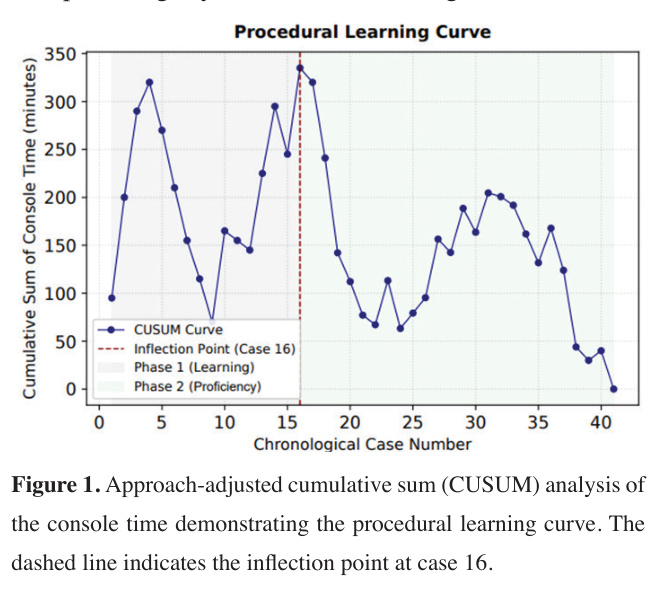
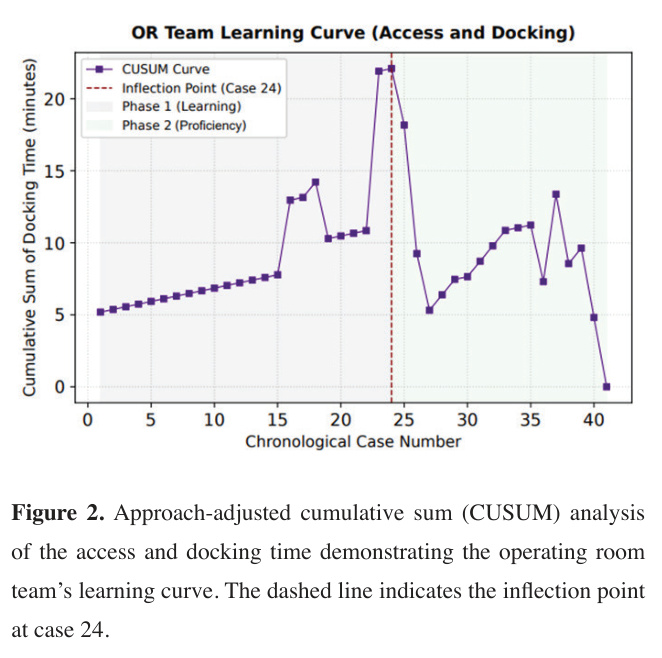
The procedural learning curve, based on the approachadjusted console time CUSUM, demonstrated an inflection point at Case 16, dividing the cohort into Phase 1 (Learning Phase, cases 1-16) and Phase 2 (Proficiency Phase, cases 17-41) (Figure 1). Conversely, the OR team’s adaptation curve, based on the approach-adjusted access and docking time CUSUM, reached its inflection point slightly later, at Case 24 (Figure 2).
)
)
 Click Here to Zoom |
Figure 1: Approach-adjusted cumulative sum (CUSUM) analysis of the console time demonstrating the procedural learning curve. The dashed line indicates the inflection point at case 16. |
 Click Here to Zoom |
Figure 2: Approach-adjusted cumulative sum (CUSUM) analysis of the access and docking time demonstrating the operating room team’s learning curve. The dashed line indicates the inflection point at case 24. |
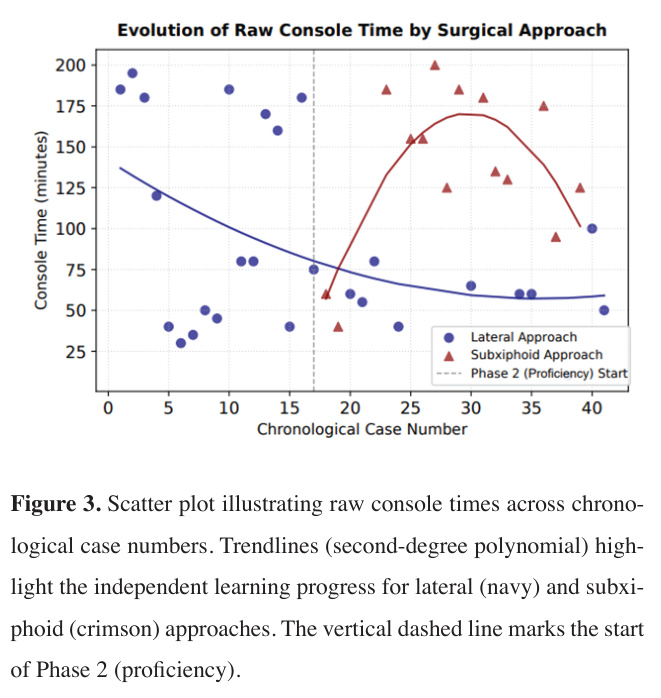
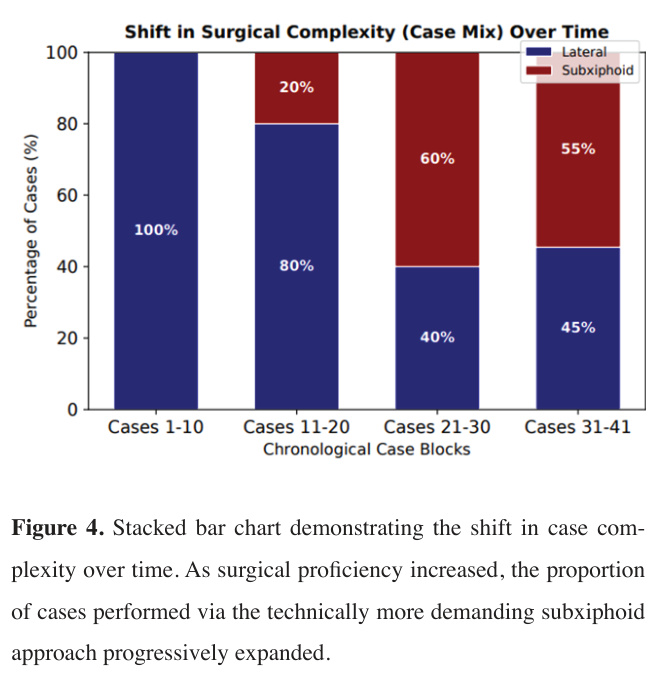
As shown in Figure 3, the raw console times initially trended downwards for the lateral approach. The subsequent introduction of the subxiphoid approach initially presented longer console times, which subsequently exhibited their own independent downward trend. The shift in surgical complexity over time is illustrated in Figure 4, confirming that as surgical proficiency increased, the proportion of cases performed via the technically more demanding subxiphoid approach progressively expanded.
)
)
 Click Here to Zoom |
Figure 3: Scatter plot illustrating raw console times across chronological case numbers. Trendlines (second-degree polynomial) highlight the independent learning progress for lateral (navy) and subxiphoid (crimson) approaches. The vertical dashed line marks the start of Phase 2 (proficiency). |
 Click Here to Zoom |
Figure 4: Stacked bar chart demonstrating the shift in case complexity over time. As surgical proficiency increased, the proportion of cases performed via the technically more demanding subxiphoid approach progressively expanded. |
Comparison of Phase 1 and Phase 2
A detailed comparison between Phase 1 and Phase 2, based on the procedural inflection point, is presented in Table 2. The approach-adjusted console time deviation showed a trend toward improvement, shifting from a median of +10.0 minutes in Phase 1 to -13.9 minutes in Phase 2 (p = 0.219). Although the raw total operative time showed a decreasing trend in Phase 2, the difference was not statistically significant (p = 0.915), primarily due to the
)
Table 1: Baseline patient demographics and operative characteristics of the study cohort.
Age (years), mean ± SD
Gender, n (%)
Female
Male
BMI (kg/m²), mean ± SD
Surgical Approach, n (%)
Lateral Decubitus
Subxiphoid
Pathology, n (%)
Thymic Cyst / Hyperplasia
Thymoma
Bronchogenic / Mesothelial / Pericardial Cyst
Schwannoma / Neurogenic
Estimated Blood Loss (mL), median (IQR)
Total Operative Time (min), median (IQR)
Access and Docking Time (min), mean ± SD
Console Time (min), median (IQR)
44.8 ± 13.4
24 (58.5)
17 (41.5)
28.5 ± 4.7
27 (65.9)
14 (34.1)
19 (46.3)
8 (19.5)
8 (19.5)
6 (14.6)
0.0 (0.0-10.0)
120.0 (80.0-180.0)
12.9 ± 5.6
100.0 (60.0-155.0)
Variable
Access & Docking Time Deviation (min), median (IQR) Console Time Deviation (min), median (IQR)
Estimated Blood Loss (mL), median (IQR)
Total Operative Time (min), median (IQR)
Conversion to Open/VATS, n (%)
Intraoperative Complication, n (%)
Postoperative Complication, n (%)
30-day Mortality, n (%)
aforementioned clustering of complex subxiphoid cases in the latter phase. It is crucial to note that Phase 1 consisted exclusively of lateral approaches (100%), whereas all subxiphoid cases were clustered in Phase 2. Therefore, raw temporal comparisons between the phases are inherently confounded by this shift in surgical approach, reinforcing the necessity of relying on the approach-adjusted (O-E) deviations as the primary indicator of procedural progression. Importantly, the intraoperative estimated blood loss was significantly reduced in Phase 2 compared to Phase 1 [0.0 mL (0.0-0.0) vs. 10.0 mL (0.0-30.0), p = 0.025]. The safety profile remained consistently high throughout the entire series. There were no conversions to VATS or open surgery in the learning phase (0% in Phase 1 vs. 4.0% [n = 1] in Phase 2, due to difficulty in anesthesia management). Postoperative complication rates were identically low across both phases (n=2 in Phase 1 vs. n=2 in Phase 2), with no 30-day or 90-day mortality observed.
Discussion
A critical challenge in evaluating learning curves in thoracic surgery is the inherent variation in case comPhase 1 (n=16)
Phase 2 (n=25)
p-value
0.2 (0.2 to 0.2)
0.2 (-3.9 to 1.1)
0.694
10.0 (-46.2 to 90.0)
-13.9 (-35.0 to 16.1)
0.219
10.0 (0.0 to 30.0)
0.0 (0.0 to 0.0)
0.025
132.5 (68.8 to 200.0)
120.0 (80.0 to 180.0)
0.915
0 (0.0)
1 (4.0)
0.390
0 (0.0)
1 (4.0)
0.390
2 (12.5)
2 (8.0)
0.635
0 (0.0)
0 (0.0)
>0.999 plexity [3,7]. In our cohort, the initial learning phase predominantly consisted of lateral decubitus approaches, whereas the technically more demanding subxiphoid approach was introduced and utilized more frequently in the latter half of the series. Standard temporal analyses often misinterpret this shift as a lack of progress, as raw operative times may not significantly decrease [8,9]. However, the approach-adjusted O-E CUSUM analysis successfully mitigated this confounding factor. Although the raw console time did not show a statistically significant reduction between Phase 1 and Phase 2 (p = 0.957), the O-E deviation demonstrated a trend toward improvement, transitioning from a median of +10.0 minutes to -13.9 minutes. This finding aligns with the learning curve thresholds of 15 to 25 cases previously reported for robotic thymic diseases, confirming that the primary surgeon achieved proficiency and subsequently applied it to more complex anatomical orientations [10-13].
Furthermore, true surgical consolidation is reflected not only in operative speed but also in tissue handling and intraoperative safety [14]. In the present study, the estimated blood loss significantly decreased from a median of 10.0 mL in Phase 1 to 0.0 mL in Phase 2 (p = 0.025). While the absolute clinical difference is small, this reduction may reflect improved tissue handling during wristed instrument manipulation and precise vascular dissection within the confined mediastinal space [15].
The dual-axis nature of our analysis revealed that OR team adaptation (access and docking time) required a slightly longer learning phase (24 cases) compared to the surgeon's console adaptation (16 cases). The subxiphoid approach, which involves a different spatial configuration and complex port placement compared to the standard lateral decubitus position, inherently prolongs setup times during the initial adoption phase [16]. The later inflection points for docking time highlights the importance of maintaining a dedicated robotic OR team to ensure standardized workflows and progressive efficiency when introducing new patient positioning techniques.
Patient safety must remain the primary priority during the adoption of any novel surgical technique. Our results demonstrated zero conversions to open surgery or VATS in the initial learning phase, with an identically low rate of postoperative complications across both phases and zero mortality. We attribute this safe transition to the completion of formal, structured robotic thoracic surgery training prior to the program's initiation. Such prerequisite training likely acts as a safeguard, ensuring that the initial learning phase represents a refinement of technique and workflow integration rather than a period of hazardous trial and error.
Limitations of the study
This study has several limitations. It is a retrospective analysis from a single center with a relatively modest sample size (n = 41). While the cohort size is sufficient for exploratory CUSUM assessment, the findings reflect the experience of a specific dedicated team and may not be universally generalizable. Additionally, while our approach-adjusted methodology effectively mitigated the temporal confounding caused by patient positioning (lateral vs. subxiphoid), we must emphasize that this is not a fully risk-adjusted model. It did not statistically account for other critical determinants of operative time, such as pathological diagnosis, lesion complexity, extent of resection, tumor size, and patient-related variables (e.g., BMI). This heterogeneity introduces inherent variability into the learning curve. Furthermore, the chronological clustering of all subxiphoid cases in Phase 2 introduces significant case-mix heterogeneity, which inherently confounds raw temporal comparisons between the phases. Due to the modest sample size of the cohort, further subgroup analyses to isolate these variables were not feasible. Future multicenter prospective studies with larger, pathology-specific subgroups are warranted to validate these proficiency thresholds. Furthermore, the identified proficiency thresholds (16 cases for the surgeon and 24 for the team) are modeldependent outcomes derived specifically from our approach-adjusted CUSUM methodology. While these numbers align with broader thymectomy learning curve literature, they should be interpreted as institutional benchmarks rather than absolute universal cut-offs.
In conclusion, our early experience suggests that a newly established robotic mediastinal surgery program can be implemented feasibly after structured training, with acceptable short-term postoperative outcomes. An approach-adjusted dual-axis CUSUM analysis reveals that the transition toward procedural proficiency and OR team adaptation occur at different phases. Objective monitoring of these distinct learning curves provides valuable insights for optimizing team workflows and safely expanding surgical indications to more complex approaches.