
Abstract
Materials and Methods: This retrospective single-center, single-operator study included 1,224 consecutive adult patients who underwent TIVAP implantation between June 2022 and January 2026. Patients with clinical conditions limiting cervical or pectoral access were classified as the restricted-access group (n = 115), while the remaining patients comprised the standard-access group (n = 1,109). Primary outcomes were revision and catheter malposition. Logistic regression analyses were performed to evaluate potential risk factors.
Results: Left-sided access (12.2% vs 1.4%, p < 0.001) and subclavian vein use (47.0% vs 20.2%, p < 0.001) were significantly more frequent in the restricted-access group. Revision rates (4.3% vs 3.7%, p = 0.612) and catheter malposition rates (1.7% vs 0.7%, p = 0.240) did not differ significantly between groups. Restricted-access status was not independently associated with revision (OR 1.08, 95% CI 0.38–3.01, p = 0.887) or malposition (OR 0.86, 95% CI 0.15–4.70, p = 0.861). Subclavian vein use was associated with catheter malposition (OR 34.84, 95% CI 4.31–281.2, p = 0.001).
Conclusions: No statistically significant increase in revision or catheter malposition risk was observed in patients with clinical conditions restricting guideline-preferred access planning. When applied within a standardized procedural framework, alternative venous access strategies may be feasible according to patient-specific anatomical conditions.
Introduction
The surgical implantation of these devices requires careful selection of the access vein. Current international guidelines recommend the right internal jugular vein as the primary choice because it provides the most direct and linear anatomical path to the right atrium [1-3].
Many studies in the literature focus on comparing various venous access routes and techniques to identify the optimal TIVAP insertion site [4,5]. However, there is a lack of large cohort studies [4,6] investigating the safety and clinical outcomes of situations where surgeons are obliged to utilize non-guideline routes, such as left-sided access or the subclavian vein, due to anatomical constraints or clinical barriers inherent in oncological surgery. This gap in the literature leads to clinical uncertainty regarding procedural safety, particularly in terms of revision requirements and catheter malposition, when practitioners must operate outside the idealized conditions proposed by current guidelines.
We evaluated whether the use of alternative TIVAP access routes in patients with anatomical or clinical constraints was associated with increased revision or catheter malposition rates. Accordingly, the aim of our study was to evaluate revision and malposition outcomes in patients with clinical conditions restricting guidelinepreferred access planning and requiring alternative access strategies when necessary.
Materials and Methods
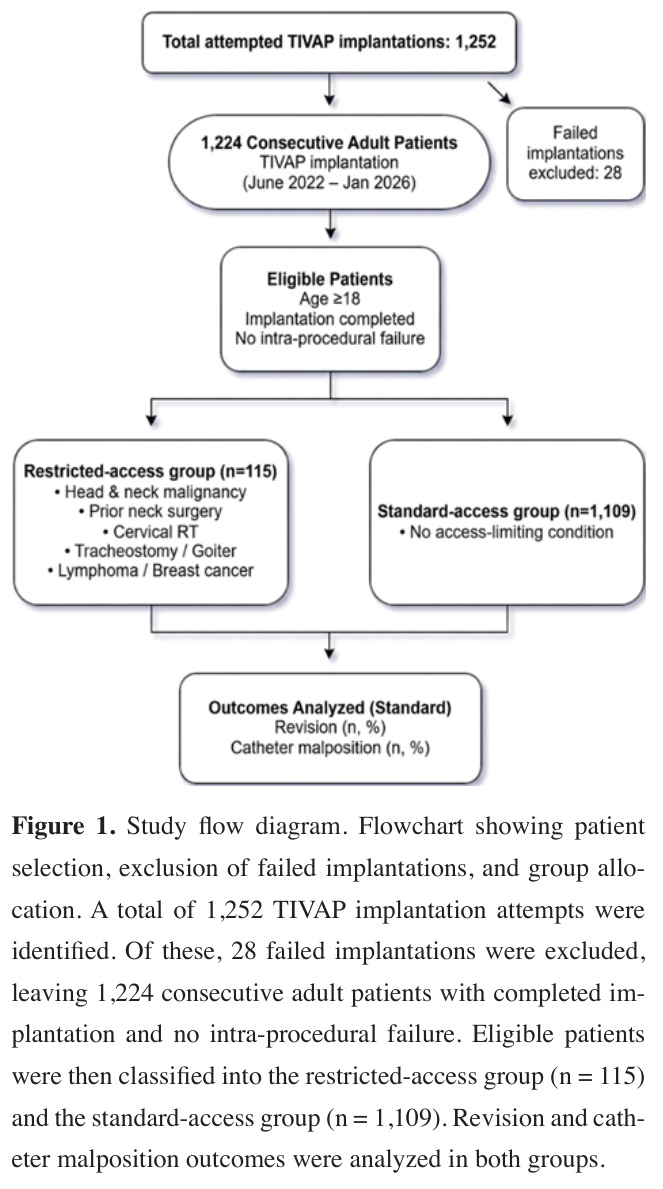
This retrospective, single-center, single-operator study included 1,224 consecutive patients aged 18 years or older who underwent TIVAP implantation at our institution between June 2022 and January 2026. Cases in which port implantation could not be completed (n =
28) were excluded. Failed implantation cases were excluded from the main revision and malposition analyses because these outcomes require a successfully implanted port system. However, these cases were reviewed separately as technical failures. The study was approved by the Clinical Research Ethics Committee of Basaksehir Çam and Sakura City Hospital (approval number: KAEK/11.02.2026.48). The requirement for study-specific informed consent was waived given the retrospective nature of the study.
Real-time ultrasound guidance was not routinely available at our institution; therefore, all procedures were performed using the anatomical landmark technique.
Patients were divided into two groups based on their diagnoses and clinical characteristics that could affect cervical and pectoral anatomy, regardless of the venous access route ultimately used for implantation. A total of 115 patients with clinical conditions influencing side selection and/or complicating access to the cervical region, including head and neck malignancies, prior neck surgery, a history of cervical radiotherapy, tracheostomy, conditions causing distortion of cervical anatomy (e.g., large goiter), as well as conditions potentially affecting pectoral access planning, including breast cancer and lymphoma, were defined as the restricted-access group. Although these conditions may not directly alter venous anatomy, they were considered clinical factors that could influence side selection or surgical planning for venous access. These conditions were considered clinical factors potentially restricting guideline-preferred access planning. Restricted-access status was defined according to preoperative clinical or anatomical conditions that could influence access planning, rather than according to the venous route ultimately used. Therefore, the term restricted-access group refers to patients with potential clinical constraints on guideline-preferred access, not to patients in whom deviation from the right internal jugular route was individually documented as mandatory in every case.
The remaining 1,109 patients without such clinical characteristics were classified as the standard-access group. After group allocation, the distribution of venous access routes (right/left and jugular/subclavian), along with demographic characteristics, comorbidities, and clinical outcomes, were analyzed in both groups. Median follow-up duration was 7.3 months (IQR: 3.0-13.0 months). Procedure
All procedures were performed in a day-surgery operating room under sedation and local anesthesia by the same surgeon using a standardized institutional protocol. Venous access was obtained using the anatomical landmark technique. Guideline recommendations were considered during procedural planning, and the right internal jugular vein was preferred whenever anatomically feasible. When right internal jugular vein access was not feasible, the procedure was performed via the right subclavian, left internal jugular, or left subclavian veins.
To minimize the risk of procedure-related pneumothorax, ipsilateral alternative access was preferred, and contralateral attempts were avoided within the same session whenever possible. If both right-sided veins were deemed unsuitable, the procedure was performed on the left side.
Post-procedural control was achieved with posteroanterior chest radiography, and patients were discharged on the same day.
Outcomes
The primary outcomes were defined as port revision and catheter malposition. Revision was defined as any surgical reintervention performed to restore the functionality or safety of the port system following the initial implantation. This included port removal, repositioning, or corrective procedures involving the catheter. In this cohort, revision procedures were performed for skin erosion at the port site. Because all revision procedures in this cohort were performed for skin erosion at the port site, revision was evaluated as a clinically relevant portsystem reintervention outcome rather than as a direct route-specific technical complication.
Catheter malposition was defined as the catheter tip being located outside the intended anatomical position, typically the cavoatrial junction, and was evaluated using posteroanterior chest radiography obtained after the procedure in all patients. Only technical placement errors related to the initial implantation were considered within the scope of malposition.
Statistical Analysis
The normality of continuous variables was assessed using the Shapiro-Wilk test. Variables with normal distribution were presented as mean ± standard deviation, whereas non-normally distributed variables were reported as median and interquartile range (IQR). Comparisons of continuous variables between groups were performed using the Student’s t-test or the Mann-Whitney U test, as appropriate. Categorical variables were expressed as numbers and percentages and were compared using the chi-square test or Fisher’s exact test.
To identify potential risk factors for revision and catheter malposition, univariable analyses were first conducted; variables with p < 0.10 in univariable analysis were entered into logistic regression models. Results were reported as odds ratios (ORs) with 95% confidence intervals (CIs). Associations between continuous variables and complications were evaluated using Spearman’s correlation analysis.
All statistical analyses were performed using IBM SPSS Statistics for Windows, Version 25.0 (IBM Corp., Armonk, NY, USA), and a p-value < 0.05 was considered statistically significant.
Results
)
)
Among all attempted implantations, 28 procedures could not be completed and were excluded from the main revision and malposition analyses because these outcomes required successful port implantation. These failed cases are summarized separately in Supplementary Table 2. Of these, 3 patients belonged to the restricted-access group and 25 to the standard-access group. Right-sided access was attempted in 25 patients and left-sided access in 3 patients. Both jugular and subclavian access were attempted in these cases. All patients were subsequently referred to interventional radiology.
)
Patients in the restricted-access group were significantly younger than those in the standard-access group (median age: 58 [IQR 46-64] vs 62 [54-69]; p < 0.001) and had a higher median body mass index (28 [24-30] vs 25 [23-29]; p = 0.004). Female sex was more frequent in the restricted-access group (59.1% vs 37.5%; p < 0.001).
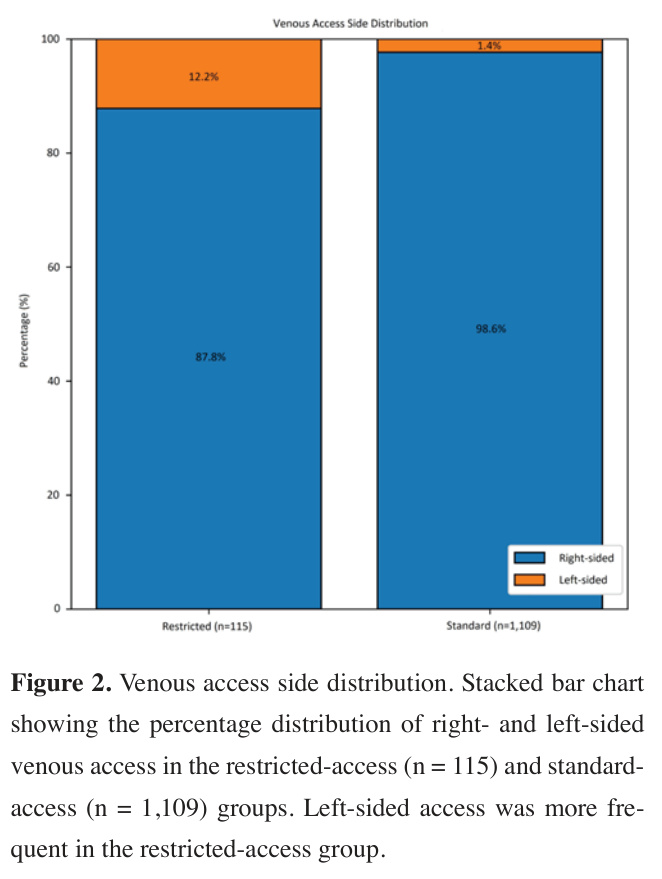
Procedural characteristics and clinical outcomes according to the restricted-access and standard-access groups are presented in Table 2. Left-sided access was significantly more frequent in the restricted-access group (12.2% vs 1.4%; p < 0.001). Similarly, subclavian vein use was more common in this group (47.0% vs 20.2%; p < 0.001). The distribution of venous access side between groups is shown in Figure 2.
)
In terms of clinical outcomes, no significant differences were observed between the groups with respect to revision rates (4.3% vs 3.7%; p = 0.612) or catheter malposition (1.7% vs 0.7%; p = 0.240). Pneumothorax occurred in 5 patients (0.4%) in the overall cohort.
Multivariable logistic regression analysis for revision risk according to the restricted-access and standard-access groups is presented in Table 3. Being in the restricted-access group was not independently associated with revision (OR: 1.08; 95% CI: 0.38-3.01; p = 0.887). Although left-sided access showed a tendency toward an increased risk of revision, it did not reach statistical significance (OR: 3.44; 95% CI: 0.88-13.28; p = 0.073). No significant associations were observed between revision and either age or body mass index.
)
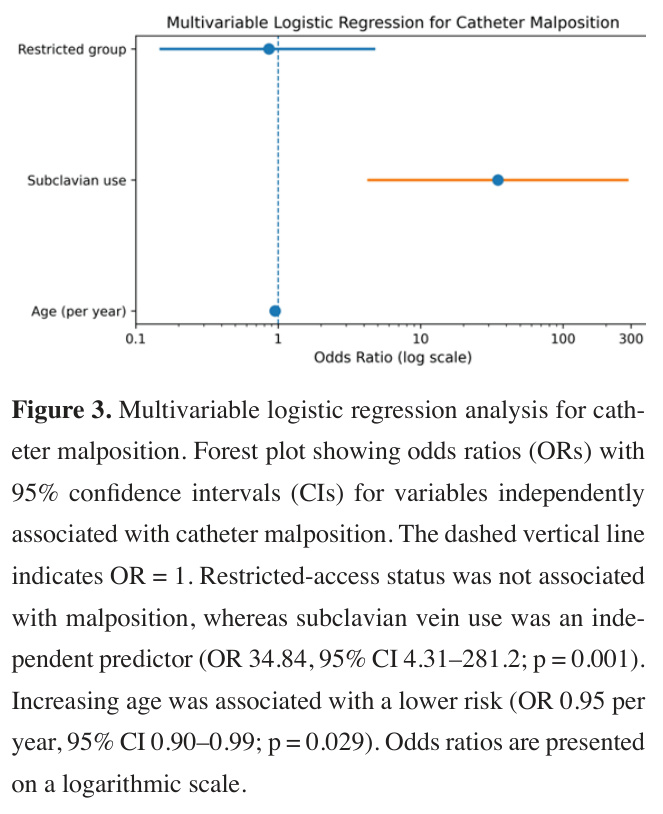
Multivariable logistic regression analysis for catheter malposition is presented in Table 4 and illustrated in Figure 3. Being in the restricted-access group was not independently associated with malposition (OR: 0.86; 95% CI: 0.15-4.70; p = 0.861). Subclavian vein use was independently associated with catheter malposition (OR: 34.84; 95% CI: 4.31-281.2; p = 0.001). Increasing age was associated with a lower risk of malposition (OR: 0.95; 95% CI: 0.90-0.99; p = 0.029). The distribution of catheter malposition events according to venous access route is presented in Supplementary Table 3. Most catheter malposition events occurred following right subclavian vein access.
)
)
The distribution of comorbidities between the groups is presented in Table 5. No significant differences were observed between the groups with respect to diabetes mellitus, hypertension, smoking status, chronic steroid use, or organ failure. Thyroid disorders were more frequent in the restricted-access group (12.2% vs 6.2%; p = 0.026).
)
Correlations between continuous variables and clinical outcomes were evaluated using Spearman correlation analysis, and the results are provided in Supplementary Table 4. Associations between comorbidities and clinical outcomes are presented in Supplementary Table 5. Overall, patient-related comorbidities were not significantly associated with procedural complications in this cohort.
 Click Here to Zoom |
Figure 1: Study flow diagram. Flowchart showing patient selection, exclusion of failed implantations, and group allocation. A total of 1,252 TIVAP implantation attempts were identified. Of these, 28 failed implantations were excluded, leaving 1,224 consecutive adult patients with completed implantation and no intra-procedural failure. Eligible patients were then classified into the restricted-access group (n = 115) and the standard-access group (n = 1,109). Revision and catheter malposition outcomes were analyzed in both groups. |
 Click Here to Zoom |
Figure 2: Venous access side distribution. Stacked bar chart showing the percentage distribution of right- and left-sided venous access in the restricted-access (n = 115) and standardaccess (n = 1,109) groups. Left-sided access was more frequent in the restricted-access group. |
 Click Here to Zoom |
Figure 3: Multivariable logistic regression analysis for catheter malposition. Forest plot showing odds ratios (ORs) with 95% confidence intervals (CIs) for variables independently associated with catheter malposition. The dashed vertical line indicates OR = 1. Restricted-access status was not associated with malposition, whereas subclavian vein use was an independent predictor (OR 34.84, 95% CI 4.31–281.2; p = 0.001). Increasing age was associated with a lower risk (OR 0.95 per year, 95% CI 0.90–0.99; p = 0.029). Odds ratios are presented on a logarithmic scale. |
Table 1: Baseline characteristics of the restricted-access and standard-access groups.
Table 2: Procedural characteristics and clinical outcomes according to access group.
Table 3: Multivariable Logistic Regression Analysis for revision risk.
Table 4: Multivariable Logistic Regression Analysis for catheter malposition.
Discussion
Anatomical and treatment-related factors inherent to oncologic care may directly influence venous access planning. Prior surgery, radiotherapy, bulky tumors, and regional anatomical distortion can restrict the use of guideline-preferred pathways and necessitate alternative strategies [7]. Under these conditions, access site selection becomes a context-dependent decision in which procedural safety must be balanced against anatomical feasibility. Therefore, adapting the access strategy to patient-specific constraints should be interpreted not as a departure from guideline-based care, but as a pragmatic application of surgical judgment.
Notably, the absence of increased complications in the restricted-access group suggests that anatomical complexity alone does not inevitably translate into technical failure. Rather than functioning as an independent determinant of risk, restricted access may represent a contextual modifier whose impact depends on how procedural strategy is adapted. This perspective is consistent with previous investigations reporting comparable complication profiles between alternative venous access routes and traditional internal jugular approaches [8].
In the restricted-access group, the significantly higher rates of left-sided access and subclavian vein use indicate that clinical factors limiting access directly influenced surgical planning. In contrast, no statistically significant differences were observed between the groups in terms of revision or catheter malposition rates. However, the revision endpoint should be interpreted cautiously. In this cohort, all revisions were performed for skin erosion, which is a multifactorial outcome and may be influenced by port pocket location, nutritional status, cachexia, local radiotherapy, infection, skin quality, and device-related factors rather than the venous access route alone. Moreover, multivariable analysis confirmed that restricted-access status was not an independent predictor of either revision or malposition. Although subclavian access was more frequent in the restricted-access group, restricted-access status itself was not independently associated with malposition. This discrepancy may reflect the limited number of events and the heterogeneity of technical strategies within the restricted-access cohort. Although left-sided access is often considered technically more demanding because of its longer intrathoracic course and the need for the catheter to traverse the left brachiocephalic vein before reaching the superior vena cava, our findings did not demonstrate a measurable increase in complications. Previous studies have nevertheless reported a higher incidence of malposition after left internal jugular access compared with right internal jugular access [9]. Although a numerical trend toward higher revision risk was observed with left-sided access, this did not reach statistical significance. Taken together, these findings suggest that approaches traditionally considered technically more demanding, such as left-sided and subclavian access, may be performed within the overall safety profile of the cohort when applied with appropriate planning and experience. Although the restricted-access group differed significantly from the standard-access group in terms of age, body mass index, and sex distribution, these variables were not independently associated with revision or malposition in multivariable analysis. The absence of an association between age, body mass index, and revision risk may reflect the consistency of a standardized singleoperator procedural approach.
In our study, the use of the subclavian vein was independently associated with catheter malposition, representing a noteworthy finding. In the subclavian approach, there is a more pronounced angulation at the junction of the vein with the right innominate vein and subsequently the superior vena cava [10]. Compared with the more linear course of the right internal jugular vein, this configuration may render catheter advancement technically more challenging and predispose to directional deviation before reaching the intended cavoatrial junction. This anatomical characteristic may partly explain the increased risk of malposition observed in subclavian access [11]. Notably, increasing age was associated with a modest reduction in malposition risk, suggesting that patient-related anatomical or physiological factors may also influence catheter positioning outcomes. Nevertheless, this finding should be interpreted cautiously given the low number of malposition events in the cohort.
Thyroid disorders were more frequent in the restricted-access group, which may reflect the higher prevalence of cervical anatomical alterations in this cohort; however, comorbid conditions overall were not independently associated with procedural outcomes.
All procedures in this series were performed using a standardized anatomical landmark technique without routine ultrasound guidance. Although real-time ultrasound is widely recommended and has been shown to improve success rates and reduce complications in many settings [12], our findings suggest that a carefully standardized landmark-based approach may remain a viable alternative in contexts where imaging is unavailable or limited. Nevertheless, current evidence and contemporary guidelines generally favor ultrasound-guided venous access because of its lower complication profile. Our findings should therefore be interpreted within the context of a landmark-based institutional practice environment. In such environments, procedural consistency, operator experience, and adherence to anatomical principles may be critical determinants of safety.
Limitations of the study
This study has several limitations. First, its retrospective design inherently carries the risk of documentation bias. Although failed implantations were excluded from the main revision and malposition analyses, their exclusion may still introduce selection bias. Therefore, these cases were reviewed and reported separately. Second, the data were derived from a single center, which may limit the direct generalizability of the findings to institutions with different practice patterns. The low number of catheter malposition events may have limited the stability of the regression coefficients and contributed to the wide confidence intervals observed for some estimates. Revision events in this cohort were limited to skin erosion, and detailed data on port pocket characteristics, cachexia, nutritional status, local radiotherapy fields, infection, and skin quality were not available. In addition, all procedures were performed using an anatomical landmark technique without ultrasound guidance, which may limit direct comparisons with centers routinely employing imaging support. Nevertheless, this uniform technical approach also allowed for a consistent evaluation of a standardized procedural strategy.
In conclusion, no statistically significant increase in catheter malposition or revision requiring surgical reintervention was observed in patients with clinical conditions restricting guideline-preferred access planning. However, revision findings should be interpreted as port-system reintervention outcomes related to skin erosion rather than direct route-specific technical complications. The increased risk of malposition was related not to restricted-access status itself but to specific technical choices, particularly the use of the subclavian vein. Our findings suggest that, when supported by appropriate planning and a standardized surgical approach, alternative venous access routes may be feasible in selected patients with anatomical or clinical access restrictions.