
Abstract
Materials and Methods: This retrospective single-center study included 152 patients who underwent pulmonary resection between October 2022 and October 2025. Prospectively collected data were analyzed retrospectively. Patients were divided into two groups: Group 1 (air leak >5 days) and Group 2 (no air leak or ≤5 days). Demographic, clinical, and perioperative variables were compared.
Results: Prolonged air leaks occurred in 20 patients (13.2%). Patients in Group 1 had lower body mass index compared to Group 2 (23.6 ± 3.8 vs. 27.1 ± 4.7 kg/m², p = 0.0009). Anatomical resection was more frequent in Group 1 (85.0% vs. 50.0%, p = 0.007). Diffusing capacity of the lung for carbon monoxide (%) was lower in Group 1 (64.0 ± 19.1 vs. 74.0 ± 22.6, p = 0.042). The length of hospital stay was longer in Group 1 (6.0 ± 2.7 vs. 4.0 ± 2.2 days, p = 0.004). No significant differences were observed in other variables.
Conclusions: Prolonged air leak remains a common complication following pulmonary resection and is associated with prolonged hospital stay. Lower body mass index and anatomical resection were significant factors associated with its development. These findings suggest that body mass index, evaluated as a continuous variable, may help identify patients at higher risk and guide perioperative management.
Introduction
PAL is generally defined as an air leak persisting for more than 5 days after pulmonary resection and is widely accepted in the literature as a standard definition [5]. This definition reflects the expected postoperative recovery period and provides a practical threshold for identifying patients with delayed resolution of air leak.
Several risk factors for PAL have been identified in previous studies, including male sex, impaired pulmonary function, and the extent and type of resection. Large database analyses have demonstrated that lower body mass index (BMI), reduced pulmonary reserve, and anatomical resections are associated with an increased risk of PAL [2]. However, despite these findings, the impact of BMI on the development of PAL remains insufficiently explored and is not consistently emphasized in clinical practice. More recent studies have also highlighted the potential role of BMI as an independent predictor of PAL, suggesting that lower BMI may reflect reduced tissue resilience and impaired healing capacity, thereby predisposing patients to prolonged air leakage [6].
The aim of this study was to evaluate the risk factors associated with PAL in patients undergoing pulmonary resection, with particular emphasis on the role of BMI and surgical characteristics.
Materials and Methods
Demographic, clinical, and perioperative data were collected from a prospectively maintained institutional database. Recorded variables included age, sex, height, weight, and body mass index (BMI). Clinical characteristics such as cardiac and other comorbidities, smoking status, and pulmonary function test parameters (FEV1, FVC, and DLCO) were documented. Diagnosis (benign or malignant) and type of pulmonary resection (anatomical or non-anatomical) were also recorded. Postoperative data included complications, presence of prolonged air leak (PAL), length of hospital stay, and in-hospital morbidity and mortality.
PAL was defined as an air leak persisting for more than 5 days after pulmonary resection. Air leak was assessed through chest tube drainage systems during the postoperative period. Patients were divided into two groups based on the presence of prolonged air leak: Group 1 consisted of patients with prolonged air leak (>5 days), while Group 2 included patients without air leak or with air leak lasting 5 days or less. Body mass index was calculated as weight in kilograms divided by the square of height in meters (kg/m²).
Smoking status was categorized as never smoker, exsmoker, and active smoker. Patients who had quit smoking for at least 2 months prior to surgery were classified as ex-smokers, while those who continued smoking up to the day of surgery were defined as active smokers.
Cardiac comorbidity was defined as the presence of coronary artery disease, valvular heart disease, or hypertension. Other comorbidities were defined as the presence of diabetes mellitus, history of malignancy, or previous major surgical procedures.
The study was conducted in accordance with the principles of the Declaration of Helsinki and was approved by the Institutional Ethics Committee of Memorial Atasehir Hospital (No: 23.04.2026/27)
Statistical Analysis
Statistical analysis was performed using SPSS software (version 25, IBM Corp., Armonk, NY, USA). Continuous variables were expressed as mean ± standard deviation and compared using the Student’s t-test or Mann– Whitney U test, as appropriate. Categorical variables were expressed as numbers and percentages and compared using the chi-square test or Fisher’s exact test. A p-value of <0.05 was considered statistically significant.
Results
± 15.1 years, and 52 patients (34.2%) were female. The mean body mass index of the entire study population was 26.6 ± 4.7 kg/m². Cardiac comorbidities were present in 70 patients (46.1%), while other comorbidities were observed in 90 patients (59.2%).
Regarding smoking status, 50 patients (32.9%) were active smokers, 59 (38.8%) were ex-smokers, and 43 (28.3%) had never smoked. A total of 126 patients (82.9%) underwent surgery for malignant disease, while
26 (17.1%) had benign pathology. Anatomical resection was performed in 83 patients (54.6%), whereas 69 patients (45.4%) underwent non-anatomical resection.
The mean length of hospital stay was 3.9 ± 2.4 days (median: 4 days, range: 1-16 days), and no in-hospital mortality was observed.
Prolonged air leaks were observed in 20 patients (13.2%), who were classified as Group 1, while 132 patients (86.8%) without prolonged air leak constituted
Group 2. The mean length of hospital stay was significantly longer in Group 1 compared to Group 2 (6.0 ±
2.7 vs. 4.0 ± 2.2 days, p = 0.004).
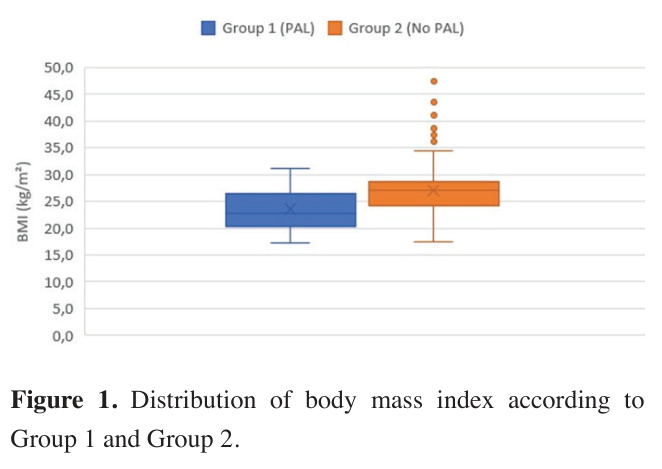
Comparisons between the two groups are summarized in Table 1. Patients in Group 1 had a significantly lower body mass index compared to those in Group 2 (23.6 ± 3.8 vs. 27.1 ± 4.7 kg/m², p = 0.0009). Similarly, DLCO (%) values were significantly lower in Group 1 (64.0 ± 19.1 vs. 74.0 ± 22.6, p = 0.042).
)
Anatomical resection was more frequently performed in Group 1 than in Group 2 (85.0% vs. 50.0%, p = 0.007). When anatomical resections were further categorized according to procedure type, wedge resection was significantly less frequent in Group 1 than in Group 2 (15.0% vs. 50.0%, p = 0.003). In contrast, lobectomy (including sleeve lobectomy) (60.0% vs. 37.1%, p = 0.084), segmentectomy (15.0% vs. 9.1%, p = 0.420), and bilobectomy (10.0% vs. 3.8%, p = 0.230) were more common in Group 1, although these differences did not reach statistical significance. No significant differences were observed between the groups in terms of age, sex, comorbidities, pulmonary function parameters, smoking status, or pathological diagnosis (Table 1). The distribution of body mass index according to group is illustrated in Figure 1.
)
Table 1: Comparison of patients with and without prolonged air leak.
Age (years)
55.7 ± 21.1
Female sex, n (%)
3 (15.0%)
BMI (kg/m²)
23.6 ± 3.8
Cardiac comorbidity, n (%)
9 (45.0%)
Other comorbidity, n (%)
12 (60.0%)
FEV1 (L)
2.62 ± 0.58
FEV1 (%)
91.0 ± 21.8
FVC (L)
3.49 ± 0.73
FVC (%)
95.0 ± 20.7
DLCO
5.39 ± 2.13
DLCO (%)
64.0 ± 19.1
Smoking status, n (%)
Active smoker
9 (45.0%)
Ex-smoker
6 (30.0%)
Never smoker
5 (25.0%)
Malignant disease, n (%)
16 (80.0%)
Anatomical resection, n (%)
17 (85.0%)
Procedure type, n (%)
Wedge resection
3 (15.0%)
Segmentectomy
3 (15.0%)
Lobectomy
12 (60.0%)
Bilobectomy
2 (10.0%)
Length of hospital stay (days)
6.0 ± 2.7
59.6 ± 14.0
0.43
49 (37.1%)
0.09
0.0009
27.1 ± 4.7
61 (46.2%)
1.00
78 (59.1%)
0.93
2.75 ± 0.83
0.39
97.0 ± 22.4
0.26
3.48 ± 0.98
0.96
99.0 ± 20.1
0.43
6.34 ± 2.11
0.075
0.042
74.0 ± 22.6
0.45
41 (31.1%)
53 (40.2%)
38 (28.8%)
110 (83.3%)
0.96
0.007
66 (50.0%)
66 (50.0%)
0.003
12 (9.1%)
0.420
49 (37.1%)
0.084
5 (3.8%)
0.230
0.004
4.0 ± 2.2
Abbrev.: BMI: body mass index; FEV1: forced expiratory volume in one second; FVC: forced vital capacity; DLCO: diffusing capacity for
Values are presented as mean ± standard deviation or number (percentage).
 Click Here to Zoom |
Figure 1: Distribution of body mass index according to Group 1 and Group 2. |
Discussion
Several studies have identified various risk factors associated with PAL following pulmonary resection, including patient-related and surgical variables [1,7]. Large database analyses have demonstrated that lower BMI is an important predictor of PAL, together with factors such as reduced pulmonary function and the extent of resection [2]. In this context, our findings are consistent with previous reports, as patients in Group 1 had significantly lower BMI values compared to those in Group 2.
Recent studies have further emphasized the role of BMI as a clinically relevant risk factor. Gioutsos et al. reported that lower BMI was associated with an increased risk of PAL following uniportal segmentectomy [6]. Similarly, risk stratification models derived from large datasets, such as the STS database, have also included lower BMI as a significant predictor of PAL [2]. These findings further support the association between lower BMI and susceptibility to postoperative complications such as PAL.
The underlying mechanisms linking relatively lower BMI to the development of PAL are not fully understood but are likely multifactorial. In the present study,
BMI was evaluated as a continuous variable rather than according to a predefined underweight cutoff. Therefore, the observed association should be interpreted as a difference in relative BMI between groups, not as an indication that patients in Group 1 were underweight according to standard BMI classifications. Patients with relatively lower BMI may have less parenchymal and soft tissue reserve, which may increase susceptibility to alveolar disruption during surgical manipulation [8]. In addition, BMI may be a surrogate marker of general nutritional and physiological reserve rather than a direct causal factor. Supporting this concept, Li et al. demonstrated that body composition parameters, particularly fat-free mass index, may be more closely associated with the risk of PAL than BMI alone [9].
In addition to BMI, the type of resection was also associated with PAL in our cohort. Procedure-specific analysis demonstrated that PAL occurred less frequently after wedge resection, whereas it was observed more often following anatomical resections, particularly lobectomy and bilobectomy. Although the differences among individual anatomical resection subtypes did not reach statistical significance, the overall distribution was consistent with the well-established association between increasing resection extent and the risk of PAL reported in previous studies [1,2]. From a technical perspective, anatomical resections require wider hilar dissection and a greater parenchymal staple line, which may increase the likelihood of persistent postoperative air leakage. In this regard, our findings support the view that surgical factors, in addition to patient-related characteristics, play an important role in the development of PAL.
The clinical impact of PAL was also evident in our study, as patients in Group 1 had a significantly longer hospital stay compared to those in Group 2. Prolonged hospitalization not only delays patient recovery but also increases the burden on healthcare systems. Previous studies have consistently demonstrated that PAL is associated with increased treatment costs, primarily driven by extended length of stay and a higher rate of postoperative complications. In a landmark study, Varela et al. showed that PAL was associated with a significant increase in hospital stay, postoperative morbidity, and overall healthcare costs following pulmonary resection [10]. More recently, Ponholzer et al. confirmed these findings and reported substantially higher healthcare expenditures in patients who developed PAL compared to those without PAL [4]. Taken together, these findings highlight that PAL is not only a clinical complication but also a significant contributor to healthcare resource utilization and cost burden.
In contrast to these findings, no significant differences were observed between the groups in terms of age, sex, smoking status, comorbidities, or pulmonary function parameters. Although previous studies have identified some of these variables as potential risk factors for PAL, the results have been inconsistent across different cohorts. These discrepancies may be related to variations in patient populations, surgical techniques, and study design.
Lower DLCO values were also observed in patients who developed PAL. Although DLCO was not the primary focus of the present study, this finding is consistent with previous reports suggesting that impaired diffusing capacity may be associated with an increased risk of PAL. Divisi et al. identified reduced DLCO as a predictor of PAL following pulmonary resection, possibly reflecting impaired parenchymal integrity and reduced pulmonary reserve [11]. However, further studies are needed to clarify the independent contribution of DLCO to PAL development.
Limitations of the study
This study has several limitations. First, it is a retrospective analysis from a single center, which may limit the generalizability of the findings. Second, certain intraoperative and postoperative factors that may influence the development of PAL, such as surgical technique, use of surgical sealants, and chest tube management strategies, were not evaluated. Furthermore, multivariate analysis was not performed because the limited number of PAL events did not allow construction of a reliable multivariable model without a substantial risk of overfitting; therefore, the findings should be interpreted as associative rather than causative. In addition, air leak assessment was based on conventional chest tube drainage systems, which may introduce a degree of subjectivity, as previously described in the literature [12]. Despite these limitations, the present study provides clinically relevant data regarding the association between BMI and PAL.
In conclusion, PAL remains a common complication following pulmonary resection and is associated with prolonged hospital stay. In this study, relatively lower BMI and anatomical resection were identified as significant factors associated with the development of PAL. These findings suggest that simple preoperative parameters such as BMI may help identify patients at higher risk of developing PAL and guide perioperative management strategies.