
Abstract
Materials and Methods: Data from 51 evaluable patients who underwent talc pleurodesis between June 2019 and April 2026 were retrospectively analyzed. Clinical success was defined as the absence of recurrence at the 1-month follow-up. Baseline pleural fluid parameters and post-procedural 2-hour systemic inflammatory markers were recorded. Features were analyzed using a regularized LASSO (L1) logistic regression model under stratified 5-fold cross-validation and visualized via global TreeSHAP analysis. Unsupervised k-means clustering was additionally implemented to identify distinct patient stratification trajectories based on inflammatory kinetics.
Results: The overall success rate was 68.6% (n = 35). Although acute post-procedural shifts occurred across traditional systemic markers, univariate analyses demonstrated no linear differentiation between outcomes. However, in the LASSO multivariate framework, baseline intrapleural total protein emerged as the strongest independent predictor of success, validated by robust AUC and TreeSHAP configurations. Unsupervised k-means clustering successfully stratified patients into distinct phenotypes, revealing that a regulated, stable inflammatory kinetic profile yields significantly superior clinical efficacy compared to an unmitigated hyper-inflammatory surge.
Conclusions: While early systemic inflammatory markers lack standalone linear predictive capacity, machine learning uncovers critical non-linear prognostic phenotypes based on acute biomarker kinetics. Baseline intrapleural total protein remains a robust local predictor, highlighting that a pre-existing exudative microenvironment, coupled with a regulated systemic inflammatory response, dictates talc pleurodesis success.
Introduction
Despite its long-standing clinical utilization, granular data fully elucidating the precise mechanisms of action of sclerosing agents remain scarce [3]. Intrapleural administration of talc triggers a robust inflammatory cascade characterized by a significant upregulation of interleukin-8 (IL-8) production [4]. IL-8 has been postulated to play a pivotal role in driving the chemotaxis of neutrophils and monocytes into the intrapleural space [5]. Talc particles activate both the visceral and parietal mesothelium. The resulting inflammatory cascade can be bifurcated into local and systemic responses. The systemic inflammatory response can be quantified by monitoring serum total white blood cell (WBC) counts, neutrophil, lymphocyte, and monocyte profiles, alongside the neutrophil-to-lymphocyte ratio (NLR) and C-reactive protein (CRP) levels [6]. However, the low specificity of these parameters poses a significant challenge in quantitatively evaluating inflammatory activity, thereby limiting their predictive value regarding pleurodesis success [7]. Consequently, current research is focused on identifying a specific indicator to precisely determine the intensity of the induced inflammatory activity within the pleural space. The objective of this study was to evaluate the early systemic inflammatory response following talc pleurodesis and to investigate its direct correlation with pleurodesis efficacy.
Materials and Methods
A retrospective cohort analysis was conducted on 58 consecutive patients who underwent talc pleurodesis at our clinic between June 2019 and April 2026. Clinical indications for the procedure included recurrent symptomatic malignant pleural effusion, recurrent spontaneous pneumothorax, and prolonged air leak.
Comprehensive data points were extracted from institutional medical records, including demographic characteristics, oncological treatment histories, and relevant comorbidities. Documented procedural and laboratory variables comprised the number of pre-procedural thoracenteses, as well as baseline serum albumin and pleural fluid characteristics including lactate dehydrogenase (LDH), albumin (Alb), glucose, total protein, pH, and cytological findings. To monitor early cellular dynamics, peripheral venous blood profiles specifically platelet (PLT) counts, white blood cell (WBC) counts, absolute neutrophil counts, and absolute lymphocyte counts were collected at baseline (pre-procedure) and 2 hours post-procedure. Systemic inflammatory dynamics were quantified using the neutrophil-to-lymphocyte ratio (NLR), platelet-to-lymphocyte ratio (PLR), and the systemic immune-inflammation index (SII), which was calculated using the standard formula: SII = Platelets × neutrophils / lymphocytes.
Pleurodesis protocol and clinical technique
Following definitive procedural indication, a standardized intrapleural protocol was executed. Local analgesia was initiated via the administration of 400 mg prilocaine hydrochloride dissolved in 50 mL of normal saline through the existing chest tube. Subsequently, 4 g of purified talc (Steritalc® F4, Novatech, La Ciotat, France) was completely dissolved in normal saline and instilled into the pleural cavity via the chest drain, followed immediately by a 50 mL saline flush to clear the lumen, after which the chest tube was securely clamped.
To maximize the homogeneity of talc distribution across both pleural surfaces, patients underwent a strict, sequential positional rotation schedule every 30 minutes during the clamping period, traversing the supine, right/ left lateral decubitus, prone, Trendelenburg, and reverse Trendelenburg positions. To safeguard the integrity of the acute localized inflammatory reaction essential for successful pleurodesis, systemic nonsteroidal antiinflammatory drugs (NSAIDs) were strictly avoided; post-procedural analgesia and pain management were restricted to intravenous tramadol HCl and paracetamol.
Peripheral venous blood samples were obtained exactly 2 hours after the completion of talc instillation. The chest tube was unclamped 4 hours post-procedure, and subsequent chest tube removal was performed based on clinical stabilization, daily drainage volumes, or the resolution of air leaks.
Response evaluation criteria
Therapeutic efficacy was evaluated 30 days post-procedure utilizing the Paladine criteria adapted for patients treated for spontaneous pneumothorax. Clinical response was categorized into three tiers: Complete Response (CR), defined as total symptom resolution with no radiological recurrence; Partial Response (PR), characterized by minimal, stable fluid not requiring therapeutic intervention; and No Response (NR), defined as symptomatic re-accumulation necessitating recurrent thoracentesis or auxiliary interventions. For binary clinical modeling, CR and PR cases were collectively designated as successful pleurodesis, while NR cases were defined as pleurodesis failure.
This study received ethical approval from the Institutional Non-Interventional Clinical Research Ethics Committee of the Gazi University (Approval No: E-77082166604.01-1537754, Date: 12/05/2026) and was conducted in accordance with the ethical principles of the Helsinki Declaration. Since the study was retrospective, the ethics committee did not require informed consent. All patient data were anonymized before analysis, and data confidentiality was maintained throughout the study.
Statistical Analysis and Machine Learning Validation Statistical analyses were performed using IBM SPSS version 26.0 and Python version 3.9. Data normality was assessed via the Kolmogorov-Smirnov test. Continuous variables were expressed as mean ± standard deviation (SD) or median with interquartile range (IQR) based on distribution, and compared using the independent Student's t-test, Mann-Whitney U test, paired t-test, or Wilcoxon signed-rank test as appropriate. Categorical variables were presented as frequencies with percentages and analyzed via Chi-square or Fisher’s exact tests. To identify distinct patient subgroups based on systemic inflammatory kinetics, unsupervised k-means clustering was implemented, with the optimal cluster count determined by the elbow method and clinical interpretability. Predictive modeling was conducted in strict accordance with the updated TRIPOD+AI statement. To prevent multicollinearity and overfitting under small-sample constraints, parameters were feature-selected using a regularized LASSO (L1) logistic regression model under stratified 5-fold cross-validation. Retained features were then transitioned into standard multivariate logistic regression to compute exact Odds Ratios (OR), 95% Confidence Intervals (CI), and definitive p-values. Model performance was evaluated using Accuracy, F1-Score, and Receiver Operating Characteristic (ROC) curve analysis for Area Under the Curve (AUC). Model interpretability was established via global TreeSHAP analysis. A two-tailed p < 0.05 indicated statistical significance.
Results
Of the 58 patients who underwent talc pleurodesis during the study period, 7 were excluded due to loss to followup or early mortality within the first month. Consequently, the final analyzed cohort consisted of 51 patients, including 33 (64.7%) males and 18 (35.3%) females, with a median age of 62.0 years (range: 24.0-85.0 years). The primary indications for pleurodesis were malignancy-associated pleural effusion (n = 47, 92.2%) and spontaneous pneumothorax (n = 4, 7.8%). Among the oncological cases, lung cancer was present in 24 (47.1%) patients and malignant pleural mesothelioma in 3 (5.9%). Positive pleural fluid cytology was documented in 23 (45.1%) patients. Comprehensive demographic and clinical baseline characteristics are detailed in Table 1.
)
Among the 51 fully evaluated patients, successful pleurodesis was achieved in 35 (68.6%), comprising 28 (54.9%) complete and 7 (13.7%) partial responses. No major procedure-related complications, including wound infections, pleural empyema, acute respiratory failure, or direct perioperative mortality, were observed within the evaluated cohort.
Dynamics of systemic inflammatory parameters
Complete blood count parameters measured immediately prior to talc pleurodesis and at the 2-hour post-procedural mark including WBC counts, platelet counts, absolute neutrophil counts, absolute lymphocyte counts, NLR, and PLR are detailed in Table 2.
)
Table 1: Characteristics of patients.
A comparative evaluation of the acute systemic inflammatory response demonstrated that peripheral platelet counts (p = 0.01) and absolute lymphocyte counts (p < 0.001) significantly decreased 2 hours after the procedure. Conversely, a significant post-procedural elevation was observed in systemically calculated indices, with both PLR (p = 0.03) and NLR (p = 0.03) values increasing significantly.
Traditional predictors of pleurodesis outcomes
Pleural fluid biomarkers and acute post-procedural systemic inflammatory parameters stratified by definitive therapeutic outcomes are summarized in Table 3. Regarding baseline parameters, both Pleural Total Protein (p = 0.019) and Pleural Albumin (p = 0.035) demonstrated statistically significant differentiation between the groups, exhibiting markedly elevated baseline concentrations in patients who achieved successful pleurodesis.
)
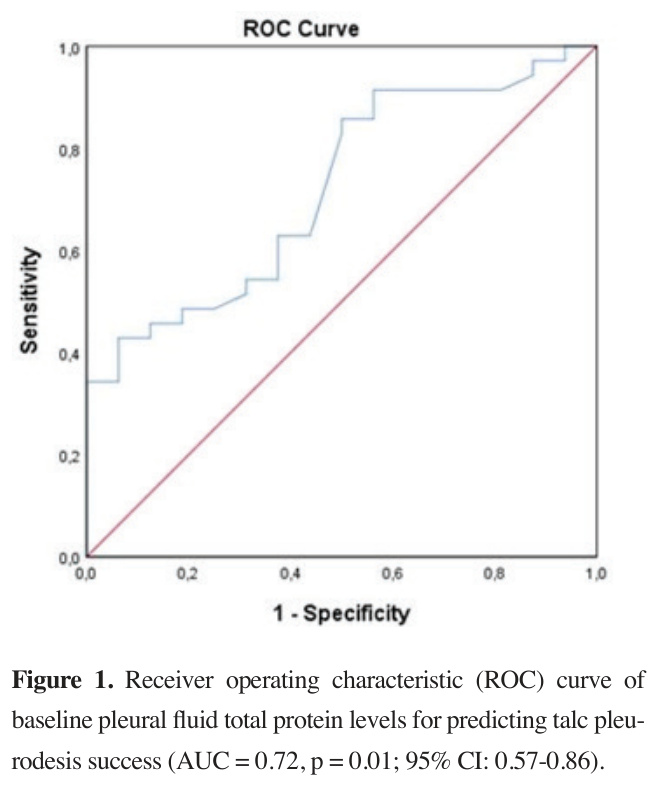
Due to the inherent biological collinearity between pleural protein components, Pleural Total Protein was selected as the primary biochemical surrogate for further single-marker diagnostic optimization. A receiver operating characteristic (ROC) curve analysis revealed that a Pleural Total Protein cut-off value of 4.01 g/dL predicted final talc pleurodesis success with a sensitivity of 62.9% and a specificity of 62.5% (Figure 1).
)
 Click Here to Zoom |
Figure 1: Receiver operating characteristic (ROC) curve of baseline pleural fluid total protein levels for predicting talc pleurodesis success (AUC = 0.72, p = 0.01; 95% CI: 0.57-0.86). |
Conversely, dynamic peripheral blood indices and cellular kinetic phases yielded no statistically significant differences between the success and failure groups. Specifically, standalone homogeneity across clinical outcomes was observed for net changes in leukocyte, lymphocyte, and platelet counts, delta NLR, PLR metrics, and the 2-hour systemic immune-inflammation index (SII), with 2-hour post-procedural NLR demonstrating only a marginal downward trend (p = 0.071).
Advanced machine learning validation and clinical modeling (TRIPOD+AI framework)
To address the limitations of conventional univariate statistics, evaluate the cumulative and non-linear predictive capabilities of these clinical, biochemical, and inflammatory variables, and fully isolate hidden independent interactions, an advanced machine learning framework was deployed in strict accordance with the updated TRIPOD+AI guidelines.
1. Strategic layered benchmarking and algorithm selection rationales
To mimic real-world clinical decision-making pathways and evaluate feature groups systematically, the evaluable cohort (n = 51) was analyzed using a stratified 5-fold cross-validation scheme across three distinct, pre-defined strategic feature layers (comprehensively detailed in Table 4).
)
Model 1 (Clinical baseline layer): Included exclusively non-invasive bedside demographics and initial clinical burden indices, namely age and the number of prior thoracenteses.
Model 2 (Isolated laboratory layer): Comprised baseline pleural fluid biochemistry including lactate dehydrogenase (LDH), albumin, glucose, total protein, pH, and cytology alongside pre-procedural and 2-hour post-procedural peripheral blood counts (WBC, platelets, neutrophils, lymphocytes) and dynamic inflammatory kinetic metrics (Baseline NLR, 2nd-hour NLR, NLR gradient, and the 2nd-hour NLR/baseline NLR ratio).
Model 3 (Combined full-stack ensemble layer): Integrated all clinical, biochemical, and early acute systemic inflammatory phases comprehensively (The complete combined features of Model 1 and Model 2).
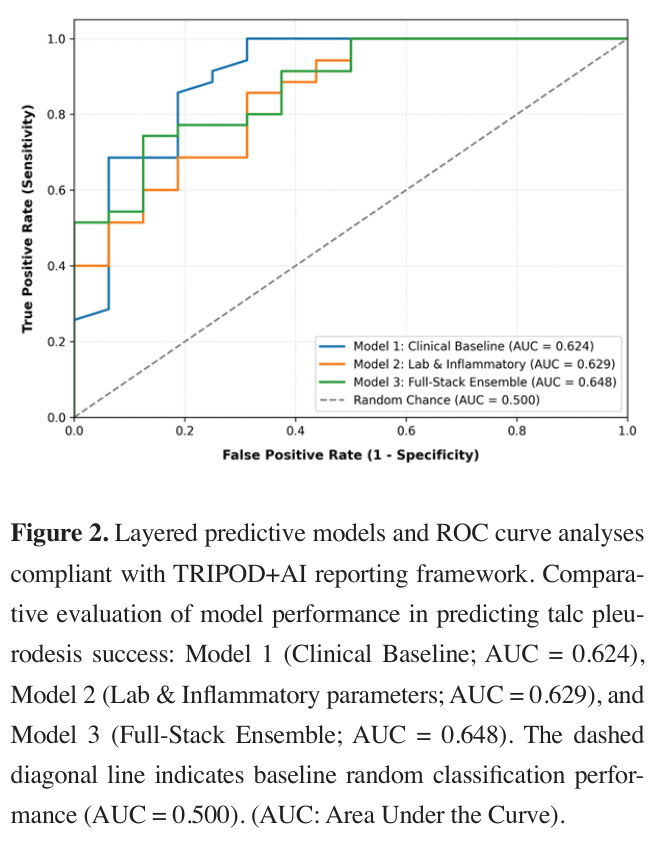
To identify the optimal mathematical fit for each data architecture, diverse algorithms including logistic regression, random forest, and XGBoost were independently trained and benchmarked within each model layer. In this competitive framework, Model 1 (Clinical layer) achieved a peak area under the curve (AUC) of 0.624 via random forest, which excelled at capturing non-linear interactions within sparse metrics. For Model 2 (Isolated Laboratory Layer), Logistic regression emerged as the top-performing algorithm with a standalone AUC of 0.629. The full integration of all parameters (Model 3) achieved the highest overall predictive performance across the entire study, where regularized logistic regression demonstrated the most robust and stable calibration, reaching a peak AUC of 0.648. Conversely, complex gradient-boosted tree architectures like XGBoost underperformed under these small-sample constraints due to a high susceptibility to overfitting. The comparative discriminatory power of these optimized layered strategic configurations is visually demonstrated in the multi-model ROC curve analysis (Figure 2).
)
 Click Here to Zoom |
Figure 2: Layered predictive models and ROC curve analyses compliant with TRIPOD+AI reporting framework. Comparative evaluation of model performance in predicting talc pleurodesis success: Model 1 (Clinical Baseline; AUC = 0.624), Model 2 (Lab & Inflammatory parameters; AUC = 0.629), and Model 3 (Full-Stack Ensemble; AUC = 0.648). The dashed diagonal line indicates baseline random classification performance (AUC = 0.500). (AUC: Area Under the Curve). |
2. Feature regularization and hybrid two-stage modeling To overcome the potential risks of overfitting and multicollinearity inherent to traditional multivariate regression in a small sample size, and to isolate the independent biological drivers without prior arbitrary p-value restrictions, a regularized LASSO (Least Absolute Shrinkage and Selection Operator - L1) logistic regression model was utilized. An initial 18-feature matrix encompassing demographics, baseline pleural biochemistry, and peri-procedural inflammatory metrics was constructed. Missing data points were managed using feature-specific median imputation to prevent target leakage. Feature selection was performed using LASSO regularization (C = 0.5), which shrank the coefficients of 12 non-contributing variables to absolute zero: number of prior thoracenteses, baseline NLR, pleural pH, pleural albumin, 2nd-hour NLR/ Baseline NLR ratio, NLR Gradient, baseline WBC, 2ndhour WBC, 2nd-hour neutrophils, 2nd-hour lymphocytes, baseline platelets, and 2nd-hour platelets. Conversely, LASSO isolated 6 predictors with non-zero coefficients: Pleural Total Protein (+0.7614), age (-0.5161), 2nd-hour NLR (-0.4121), baseline lymphocytes (-0.0711), serum albumin (+0.0126), and baseline neutrophils (-0.0120). These 6 optimized features were subsequently entered into a multivariate logistic regression model to calculate the final clinical coefficients. The hybrid model was evaluated using both whole-cohort optimization and Stratified 5-Fold Cross-Validation to assess out-of-fold (OOF) generalizability (Table 5). While internal optimization yielded a peak AUC of 0.852 and an accuracy of 78.4%, the cross-validated pipeline demonstrated a stable mean OOF AUC of 0.702 and a mean accuracy of 64.7%. The cross-validated metrics aligned within the baseline 95% confidence intervals (F1-Score: 0.741, Sensitivity: 74.3%, positive predictive value [PPV]: 74.8%), confirming model stability. However, due to sample size constraints, the mean OOF specificity settled at 45.0%.
)
Within this final regularized clinical configuration, Pleural Total Protein was confirmed as a significant independent positive predictor of pleurodesis success (OR = 3.192, 95% CI: 1.093-9.326, p = 0.034). Conversely, among the remaining features retained by the regularized framework, advanced age (OR = 0.938, 95% CI: 0.8781.002, p = 0.056) and the 2nd-hour post-procedural NLR (OR = 0.827, 95% CI: 0.672-1.018, p = 0.073) demonstrated notable negative trends, showing an inverse biological direction toward clinical success despite falling just outside the conventional alpha threshold (Table 6). 3. Explainable AI and feature hierarchy
)
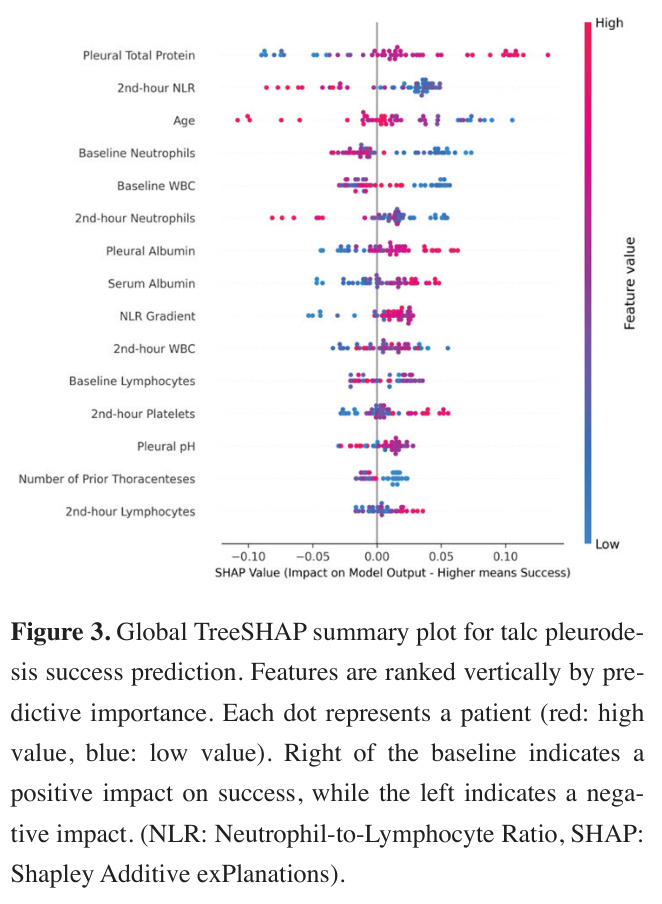
To unravel the "black-box" nature of the algorithmic framework and provide transparent clinical interpretability, a global TreeSHAP (Shapley Additive exPlanations) analysis was performed on the optimized final model (Figure 3).
)
Table 4: Comprehensive feature layer architecture and multi-algorithm benchmarking matrix.
 Click Here to Zoom |
Figure 3: Global TreeSHAP summary plot for talc pleurodesis success prediction. Features are ranked vertically by predictive importance. Each dot represents a patient (red: high value, blue: low value). Right of the baseline indicates a positive impact on success, while the left indicates a negative impact. (NLR: Neutrophil-to-Lymphocyte Ratio, SHAP: Shapley Additive exPlanations). |
Hierarchical ranking of the features demonstrated that Pleural Total Protein exerted the most profound global impact on model decisions, where elevated levels (red dots) heavily drove the model output toward pleurodesis success. Notably, the 2nd-hour NLR emerged as the second most critical determinant in the hierarchy. Lower 2nd-hour NLR values (blue dots) were tightly clustered on the positive SHAP axis. Conversely, advanced age and elevated baseline neutrophils negatively impacted the probability of success.
4. Unsupervised patient stratification: k-means clustering analysis
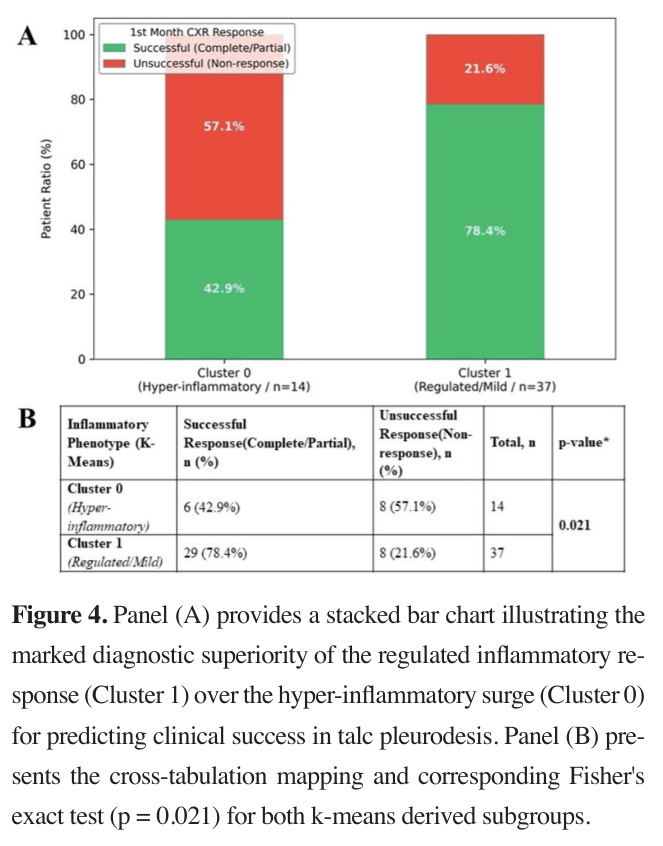
To look beyond supervised predictive classifications and structurally identify natural, distinct patient sub-populations based entirely on post-procedural systemic inflammatory behaviors, an unsupervised k-means clustering analysis was executed. The algorithm mathematically stratified the evaluable cohort (n = 51) into two discrete biological trajectories: Cluster 0 (n = 14) and Cluster 1 (n = 37). Profile analysis of these clusters revealed that Cluster 0 represented a Hyper-inflammatory phenotype, characterized by a profound escalation in the 2-hour post-procedural neutrophil-to-lymphocyte ratio (mean 2.h NLR: 13.82) accompanied by marked acute leukocytosis. Conversely, Cluster 1 represented a regulated/ mild phenotype, exhibiting highly stable and well-controlled systemic biomarker kinetics with a significantly lower 2-hour post-procedural NLR (mean 2.h NLR: 5.53). When these unsupervised, laboratory-driven mathematical clusters were crossed with definitive clinical outcomes, a highly significant correlation was observed. In the regulated/mild phenotype (Cluster 1), the definitive clinical pleurodesis success rate was exceptionally high at 78.38% (29 of 37 patients). In stark contrast, the hyper-inflammatory phenotype (Cluster 0) yielded a significantly lower clinical success rate of only 42.86% (6 of 14 patients), with the majority of these patients (57.14%, n = 8) presenting with definitive non-response/treatment failure. Cross-tabulation mapping and subsequent statistical evaluation confirmed that this unsupervised phenotypic distribution was significantly associated with final clinical outcomes (p = 0.021; Figure 4).
)
 Click Here to Zoom |
Figure 4: Panel (A) provides a stacked bar chart illustrating the marked diagnostic superiority of the regulated inflammatory response (Cluster 1) over the hyper-inflammatory surge (Cluster 0) for predicting clinical success in talc pleurodesis. Panel (B) presents the cross-tabulation mapping and corresponding Fisher's exact test (p = 0.021) for both k-means derived subgroups. |
Discussion
Chemical pleurodesis with talc is frequently performed to obliterate the pleural space, thereby alleviating dyspnea and improving patient comfort. A meta-analysis of 18 studies utilizing sterile talc reported pleurodesis success rates between 76% and 82% [9]. In our study, the success rate was 68.6%, which is lower than the reported literature. This discrepancy may be attributed to our sample size limitations as a single-center study.
Habal et al. evaluated local and systemic inflammatory parameters in 114 patients with recurrent malignant pleural effusion undergoing talc pleurodesis [7]. When comparing the successful (n = 98, 86.0%) and unsuccessful (n = 16, 14.0%) groups, they reported that serum leukocyte counts began rising after the 12th hour in both cohorts. However, leukocyte levels were significantly higher in the successful group during peak periods between the 36th and 60th hours (p36.h = 0.002, p48.h = 0.0001, p60.h = 0.0001). In pleural fluid analysis using flow cytometry, a marked decrease in lymphocyte percentage and a prominent increase in granulocyte percentage were observed, though no statistically significant difference was reported between the two groups. Similarly, Mercer et al. reported the outcomes of 285 patients undergoing talc pleurodesis for malignant pleural effusion, noting an overall success rate of 81.4% (232/285) at the third month [10]. Regarding serum leukocyte dynamics, the difference in leukocyte elevation between the successful (2.35 × 10⁹ /L, SD: 2.94, 95% CI: 1.92-2.78) and unsuccessful (1.79 × 10⁹/L, SD: 2.44, 95% CI: 1.00-2.58) groups was not statistically significant. However, leukocyte levels increased significantly in both groups when comparing day 0 to day 1 post-procedure (p <0.001 for both). In our study, although an increase in leukocyte and granulocyte counts was observed in peripheral venous blood samples at the 2nd hour, it did not reach statistical significance. Evaluated alongside the literature, these findings suggest that early-phase alterations in leukocyte and granulocyte counts lack the capacity to independently predict pleurodesis success. Furthermore, while a significant decline in lymphocyte counts was observed consistent with previous reports, it displayed no meaningful association with ultimate clinical outcomes.
In addition to acute inflammation, fibrotic mechanisms play a vital role in establishing effective pleurodesis [3]. Platelets are core components of the coagulation cascade; notably, an inverse relationship between fibrinolytic activity and pleurodesis success has previously been demonstrated via d-dimer measurements [11]. Furthermore, direct intrapleural instillation of TGF-β, a potent pro-fibrotic cytokine, has been shown to induce pleurodesis at a faster rate than talc in rabbit and sheep models [12,13]. Platelets contain 40 to 100 times more TGF-β than other circulating cells and are estimated to source approximately 45% of baseline plasma TGF-β levels [14-16]. Collectively, these insights underscore the impact of platelets on the fibroticfibrinolytic equilibrium during the pleurodesis cascade. However, literature regarding platelet count dynamics in patients undergoing talc pleurodesis remains virtually non-existent. In our cohort, while a significant post-procedural decline in serum platelet counts was observed, this alteration exhibited no direct statistical association with ultimate pleurodesis success.
The peripheral blood NLR is a well-established marker of immune-inflammatory dynamics and a cost-effective parameter for assessing clinical severity [17,18]. Furthermore, early alterations (<6 hours) in neutrophil and lymphocyte counts following acute physiological stress position these cellular indices as timelier biomarkers compared to traditional laboratory parameters like total white blood cell (WBC) count and C-reactive protein (CRP) [17]. Zablockis et al. evaluated systemic inflammatory responses and pleurodesis outcomes in 96 patients utilizing non-graded talc, graded talc, bleomycin, or mitoxantrone [6]. In their study, which achieved successful pleurodesis in 81 patients (84.4%; comprising 39.6% complete and 44.8% partial responses), systemic inflammatory markers were assessed using 24-hour post-procedural serum samples. Their findings indicated that serum NLR levels elevated uniformly across all therapeutic agents at the 24th hour. Moreover, comparative analyses between the successful and unsuccessful pleurodesis cohorts demonstrated that baseline NLR, 24-hour post-procedural NLR, and longitudinal NLR dynamics failed to predict ultimate pleurodesis success. Consistent with the literature, our results demonstrate that 2nd-hour serum NLR levels increased significantly as an indicator of acute inflammation. This early evaluation captures the immediate neuroendocrine-driven immune cell redistribution before delayed systemic cascades fully manifest. According to the kinetic model described by Dhabhar et al., acute stress triggers a time-dependent cellular shift within 30 to >120 minutes, wherein lymphocytes traffic out of the blood into target tissues while neutrophils exhibit sustained mobilization [19]. Therefore, the 2ndhour NLR captures a dynamic window of this leukocyte redistribution, minimizing confounding by subsequent secondary processes. However, while conventional univariate analysis failed to establish a direct relationship between this acute NLR shift and pleurodesis success, this clinical signal was successfully isolated through our two-stage hybrid AI approach by capturing the synergistic variance among features. Within this regularized framework, post-procedural 2nd-hour NLR emerged as the second most critical determinant. Our explainable AI (TreeSHAP) analysis illuminated this mechanism, revealing that lower 2nd-hour NLR values were associated with positive SHAP values. Clinically, this suggests that a controlled, non-exaggerated early systemic response following talc insufflation is a prerequisite for successful pleurodesis maturation. Our unsupervised kmeans clustering further supports this model; patients with a well-controlled inflammatory profile yielded substantially higher success rates than those experiencing a post-procedural hyper-inflammatory surge. Biologically, this highlights an 'optimal inflammatory window', suggesting that while a baseline exudative environment primes the pleura for fusion, an unmitigated early systemic storm may trigger local tissue degradation and excessive exudation that mechanically hinders stable fibrin bridge organization.
Both thrombocytosis and lymphopenia are intrinsically linked to the severity of systemic inflammation, and the PLR provides a composite biomarker integrating both hematological indices [17]. The prognostic utility of PLR has been extensively investigated in various inflammatory conditions, including its combined use with NLR to evaluate disease activity in rheumatological disorders [20]. However, studies exploring the relationship between PLR and talc pleurodesis efficacy remain absent. In our cohort, although 2nd-hour post-procedural PLR levels increased significantly, they failed to independently predict pleurodesis success.
The Systemic Immune-Inflammation Index (SII) was first defined by Hu et al. in 2014 and is calculated using the formula of (Platelets x Neutrophils) / Lymphocytes [21]. These peripheral blood cells play pivotal roles in numerous inflammatory cascades. Consequently, SII has emerged as a prognostic biomarker across various diseases, particularly in malignancies and cardiovascular disorders. However, its clinical utility as a standalone parameter remains limited due to threshold uncertainties and study heterogeneities [17]. To date, no published data directly link SII with talc pleurodesis outcomes. Our data revealed a significant post-procedural elevation in 2nd-hour SII levels. Nevertheless, when stratified by clinical response, no statistically meaningful association was found between SII and ultimate pleurodesis success.
The relationship between pleural fluid characteristics and talc pleurodesis success remains controversial in the literature. Ferreiro et al. evaluated the pleural fluid analysis of 36 patients undergoing talc pleurodesis for malignant pleural effusion achieving success in 26 patients (72.2%) and reported no significant differences between the successful and unsuccessful groups regarding pleural fluid pH, glucose, total protein, albumin, or lactate dehydrogenase (LDH) levels [22]. Conversely, Ukale et al. evaluated 89 patients with malignant pleural effusion undergoing pleurodesis with either talc (n = 48) or mepacrine/quinacrine (n = 41), achieving an overall success rate of 91.0% (n = 81) [23]. In their post-procedural pleural fluid analysis, glucose levels were significantly higher in the successful group (5.34 ± 2.57 vs 3.06 ± 1.54, p = 0.05), whereas no meaningful difference was noted in pH values (7.52 ± 0.35 vs 7.64 ± 0.58, p = 0.52). However, their statistical evaluations were limited to univariate comparisons without accounting for potential confounding variables through multivariate regression models, thereby restricting strong causal inferences. Although published data are limited, an exudative pleural fluid profile typically reflects a more pronounced local inflammatory state within the pleural space [24]. In our cohort, baseline pleural fluid protein was validated as the strongest independent positive predictor of pleurodesis success in both univariate analysis (p = 0.006) and the LASSO-optimized multivariate final model (p = 0.034). Specifically, an increase in baseline pleural fluid protein levels elevated the odds of pleurodesis success by 3.192-fold in the multivariate matrix. This parameter also occupied the apex of the SHAP hierarchy, where higher values clearly demonstrated that pre-existing, local exudative/inflammatory activity within the intrapleural space primes the pleural environment for the subsequent talc-induced granulomatous reaction, thereby directly driving clinical success. Consequently, this study provides an innovative, AI-driven framework that enables clinicians to predict patient-specific pleurodesis outcomes by evaluating the baseline pleural fluid protein profile prior to the procedure, a clinical insight that warrants further validation through prospective trials.
Limitations of the study
Our study is subject to several limitations that warrant consideration. First, its retrospective nature inherently introduces potential selection biases. Second, it was conducted as a single-center study with a relatively small sample size (n = 51). However, this sample limitation was mathematically addressed by utilizing the regularized LASSO (L1) penalization method to shrink 12 noise-generating variables to zero. Furthermore, since whole-cohort optimization inherently carries an overfitting risk in small datasets, a Stratified 5-Fold Cross-Validation framework was implemented to determine the true out-of-fold (OOF) performance and establish realistic generalizability boundaries. Third, because some patients had received various oncological treatments prior to the procedure, a complete standardization of oncological therapies could not be achieved. Despite these limitations, confirming the validity of our machine learning-based findings through prospective, multi-center studies with larger patient cohorts remains of paramount importance.
In conclusion, while conventional univariate analyses suggest early systemic inflammatory parameters lack linear predictive capacity, our machine learning framework successfully identifies distinct prognostic phenotypes based on acute biomarker kinetics. Specifically, a regulated, stable inflammatory profile significantly outperforms an unmitigated hyper-inflammatory surge in predicting clinical efficacy, while baseline intrapleural total protein remains the strongest independent positive predictor. Utilizing this explainable AI methodology provides clinicians with a powerful framework for patient-specific pleurodesis outcomes, though future prospective trials remain essential for validation.